Brought To You By Emily Parks
Productivity Consultant at Organize For Success, LLC...
Helping You Make Every Minute Matter!


Showing posts with label new year's resolution. Show all posts

Wednesday, January 31, 2018

Visualize Your Ideal Life to Make It Happen

The fundamentals of productivity build upon one another... You clarify what matters most, utilize those priorities to create a game plan for proactively addressing the week, utilize a daily wrap-up to stay on track and, yet, sometimes, still miss out on attaining your loftiest of goals. The missing link might have more to do with visualization of your goals than the tactics you use to get through each day.

Have you ever heard the saying that "Seeing is believing"? As the Huffington Post explains, "Before we can believe in a goal, we first must have an idea of what it looks like... This is where visualization comes in, which is simply a technique for creating a mental image of a future event." It is through visualizing our experience of desired results that we can see, feel, smell, taste and hear all that success offers, fueling even greater emotional drive to meet goals.

One of the most successful methods is outcome visualization, where you create a detailed mental image of the desired outcome using all of your senses, putting yourself in the situation of achieving your goal to envision every little detail. This could be drawings, words, diagrams or a vision board, but the key is dig into the details as you create a visual representation of that outcome.

Another of the most successful methods is process visualization, where you envision each of the actions necessary to achieve the outcome you want, focusing on exactly how to complete each steps needed to achieve your goal rather than the end result.

At the end of this year, how will you have spent your days? What will be your gross revenue? How many of what types of clients will have hired you? What new things will you have tried or what helpful habits will you have developed? What did you stop doing?

Write out your answers; then, determine exactly what needs to occur to make your vision a reality. What resources do you need to procure? What partnerships do you need to initiate? What marketing efforts do you need to schedule? What sort of training do you need to acquire? With whom do you need to interact more?

Need help? Try Jack Canfield's step-by-step to get started.

What is your vision for your ideal life? What needs to occur to make that vision a reality? Share your experience with these visualization techniques and share your successes.

Saturday, January 6, 2018

Knowing Where You're Headed Helps in Getting There

At times, it seems like the world is conspiring against anyone's attempts at productivity. You sit down at your computer to work on a major project, and your mind wanders to all the things you've forgotten to address; you see a pop-up notifying you of a new email, and an alert appears on your smartphone that someone liked your photo on Facebook. The phone begins ringing. Then, someone appears at your office door in a panic and needing your help. How can anyone actually get anything done?!?

When you know where you're headed, you are better enabled to get there. If you create a strategy each week for how to best address what matters most, you have a clear, meaningful path for achieving your priority goals. To make this work, it's important to utilize your weekly strategy as a protective barrier, warding off time stealers and others' priorities, like your own personal suit of armor.

With a weekly strategy, you know which tasks, communications, time commitments and development opportunities focus on your priorities, fueling achievement of your goals. If you don't use this strategy to protect yourself from the world's distractions and conflicting priorities, it's easy to get swept up in reactionary measures, losing vision of what matters most.

Stop getting swept up in what's urgent but unimportant. Stop reacting. Start using your weekly strategy to proactively invest in what's important. Grow confident that you can consistently work toward your priority goals by wearing your protective barrior.

How do you utilize your weekly strategy to ward off time stealers and others' priorities? Have you ever considered how your strategy can protect you from deviating away from what matters most?

Friday, January 5, 2018

Be Proactive with a Weekly Strategy Session

Imagine it's Friday afternoon and you're preparing to walk out the door for the weekend. Looking back on the work week that's ending, how accomplished are you feeling? Did you effectively address what was important for work, home, your community and yourself? Or did you get pulled into others' priorities, spend your week putting out fires and neglect your goals?

If you feel less successful than you'd like, take steps to better address what matters most in upcoming weeks.

Those who have ever played or worked in athletics know there are many preparations that occur before each game, including scouting the opponent, preparing equipment and creating a game plan. Yes, during the game itself, there will be adjustments based off how the other team plays, but coaches would never lead their teams into athletic competitions without creating a game plan beforehand. It is about proactively creating the direction in which you will proceed rather than simply reacting to what's thrown your way, and the same philosophy applies to addressing your priorities for work, home, your community and making yourself the best possible.

Take control of your productivity by creating your own weekly strategy, which is a specific game plan for how you'll address your priorities in each of the following ways:

  • Carryover Tasks - Evaluate which of the tasks you'd planned to do during the week that's ending were actually completed; determine what's left undone and when those undone tasks can be rescheduled. Be honest with yourself about what you are actually willing to do. If not you, then who can accomplish what needs to get done? What can you delegate? Does each incomplete task truly need to happen or can any be deleted? 
  • Team Communications - Get in-depth updates from each member of your team (at work, at home, involved with the community projects you're currently addressing or those with whom you've contracted to get more done), seeking input on what is working, what is not working and what needs attention.
  • Client Communications - Catch-up on processing outstanding emails, phone calls and snail mail. Reach out to schedule time with those who have been needing your attention. Touch bases with clients from whom you've not heard lately, whether with gratitude, to wish a happy birthday or simply seeing how things are going. Sometimes, reaching out should include a call to action; however, realize that reaching out without a call to action can provide even greater results in certain scenarios.
  • New Tasks - As every project should be broken down into smaller, more manageable action steps with associated deadlines for their timely completion, there is a good chance upcoming deadlines are approaching, and there are tasks related to those deadlines that need addressing in the upcoming week. Decide which new tasks should be added to your to-do list, ensure you are clear on their associated deadlines, and make time for taking action to get them done.
  • Time Commitments - Review the next week's appointments to make certain you're prepared for all related tasks, ensuring there is time for necessary preparations and travel to each. Do you need to incorporate any additional buffers for traffic or unforeseen things that'll pop up? Do you know which will occur in person, over the phone or via video conference? Are you clear about how to get to each of the in-person commitments?
  • Development - Never neglect a focus on continually improving yourself. Determine opportunities for personal and professional growth; what will move you towards your goals? This could be training, networking or anything focused on fueling your desired results. Review what upcoming options have come to you via email, snail mail, websites you've seen or conversations you've had, and make decisions about which can earn space on your calendar, registering to attend once you've determined you will.

It is less important when you complete this process as compared to whether or not you get it done at all; many like to wrap-up the week with a weekly strategy session on Friday, Saturday or Sunday, but choose which works best for your unique situation.

Be strategic and map out a specific game plan for addressing all that needs your attention. Keep in mind each of the elements for work-life integration: work, home, community or society as well as the private realm of mind, body and spirit. As each of these elements is a layer of life with rotating levels of emphasis, focus on how you can best invest the upcoming week's 168 hours to address the current priorities within each realm of your life.

Especially when you first start implementing the weekly strategy session, set a timer. Knowing you have a certain amount of time in which to complete this checklist will keep you focused and better ensure your planning doesn't run longer than necessary.

Do you take time at the end of each week to properly plan the week ahead and proactively address your priorities? How does this equip you for greater productivity? On the flip side, what issues have you encountered when you haven't been able to plan adequately before starting your week?

Tuesday, January 24, 2017

How Are Your Resolutions Coming? Or Do You Have a "Word of the Year" Guiding Your New Year's Direction?

The beginning of a new year often presents a fresh start and is an ideal time to develop new habits, attack new goals and "be better" or "do better" in whatever areas of life have been challenging. Yet, for many of us, motivation and momentum starts to wane a bit after a few weeks. Life gets in the way, distractions arise, your annual battle with bronchitis comes back with a vengeance or you move on to whatever might be bigger and better at that moment.

Research tells us 92% of new year's resolutions fail. There are a number of reasons resolutions fail, including overly ambitious targets, vague details and peer pressure, but the fact remains that resolutions are rarely successful in driving change.

What if we tried something different for this calendar year?

I've heard more and more people moving away from new year's resolutions; instead, we're setting a theme by picking one word to summarize who we want to be, what we want to accomplish and our overall desire for directing our actions in 2017.

It won't really matter what word you choose as long as it resonates with you and your vision for the new year. How do you want to feel? What goals do you want to accomplish at work, at home, in the community and for yourself? What are your dreams and big, hairy, audacious goals? What successes would make you proudest?

For 2017, I have chosen "uplevel" as my word of the year. According to the Urban Dictionary, uplevel means "to transform and grow in an area previously stagnant." This covers everything from my network connections to the service I provide clients, how present I am when hanging out with friends to how organized I keep my home and how proactive I am in my Lung Cancer Initiative volunteering to my dedication for working out at least once per week at LifeTime Fitness. It's an all-encompassing goal!

If you create new year's resolutions, how successful are you each year? Alternatively, have you considered replacing your new year's resolutions with a word for your new year? If you chose a word for this year, what is your for 2017?

Monday, February 1, 2016

Maintain What Systems You Create

As we start February, it is time to reflect on the progress made thus far this year. On this blog, we have covered so much ground throughout January. From habits that will aid being proactively productive to tools that one can implement for better or more efficient results, there are so many tiny tips to fuel your successes.

Yet, the 31 posts I've shared to jumpstart your new year are only the start. It is important to get organized and create systems; however, maintaining your organization is where productivity fuels true success. The challenge moving forward is to maintain what foundation has been developed.

Since none of us can envision all the hurdles we will face going into making changes, be reassured that backsliding is normal and to be expected. However, how we respond to those hurdles and any regression that occurs will determine our ultimate success.

Ask others for help to keep you on track. When you share your goals and what actions you are taking to achieve your desired results, you create a type of accountability that helps. Still, outwardly soliciting others' support is even more powerful.

Take charge of what resources are available to you. Sign up for free newsletters that will continually remind you of where you want to be headed. Join Facebook groups or Google+ circles that can provide ongoing support with changes you'd like to maintain.

Utilize reminders to stay the course. Set alarms on your mobile devices to trigger your new habits. Add sticky notes or labels around your workspace, home or vehicle as visual aides.

Be willing to continually review your progress. What works for someone else often won't work for you so you might need to tweak what habits, techniques and tools you've adopted to best meet your personality and specific needs. Plus, as the world around you evolves, your needs will change, and  you'll need to adapt suitably.

Take action to overcome common impediments to change, and you'll reap the benefits of success throughout the year. 

What have you implemented from my posts throughout January to jumpstart your new year? What is your game plan for maintaining that organization so your enhanced productivity can fuel your true and continued success?

Thursday, January 7, 2016

Jump-Start Your Morning

How you start each day can lay the foundation for how things will go all day long. When you oversleep and race frantically out the door, it can make you stressed and frazzled throughout your entire day. Alternatively, if you have a set morning routine that builds up your energy, keeps you happy and smooths your way out the door with time to spare, that positive energy can fuel your day.

Jump-start each morning with these 3 simple steps:

- Remove unnecessary actions from your morning routine. Do you really need to empty the dishwasher or pick-up your child's toys? If the task is not getting you closer to walking out the door, at what time can it be scheduled for doing later?

- Streamline your processes for getting ready each day. Is there a breakfast option which is easier to prepare that you can have daily? Might you be able to simplify styling your hair or how you apply make-up?

- Use hacks to boost your energy from the start of each morning. What can you do to get up and moving immediately? Would there be any early workout you could start or should you try the 7 Minute Workout app? Do you have an upbeat playlist in your music that you could incorporate in your morning routine? Plus, drinking a tall glass of water with a squeeze of lemon juice will certainly improve your morning energy level.

How do you regularly start your day? Have you found success with anything I've shared? Which of these will you be incorporating in your upcoming mornings' routine?

Tuesday, January 5, 2016

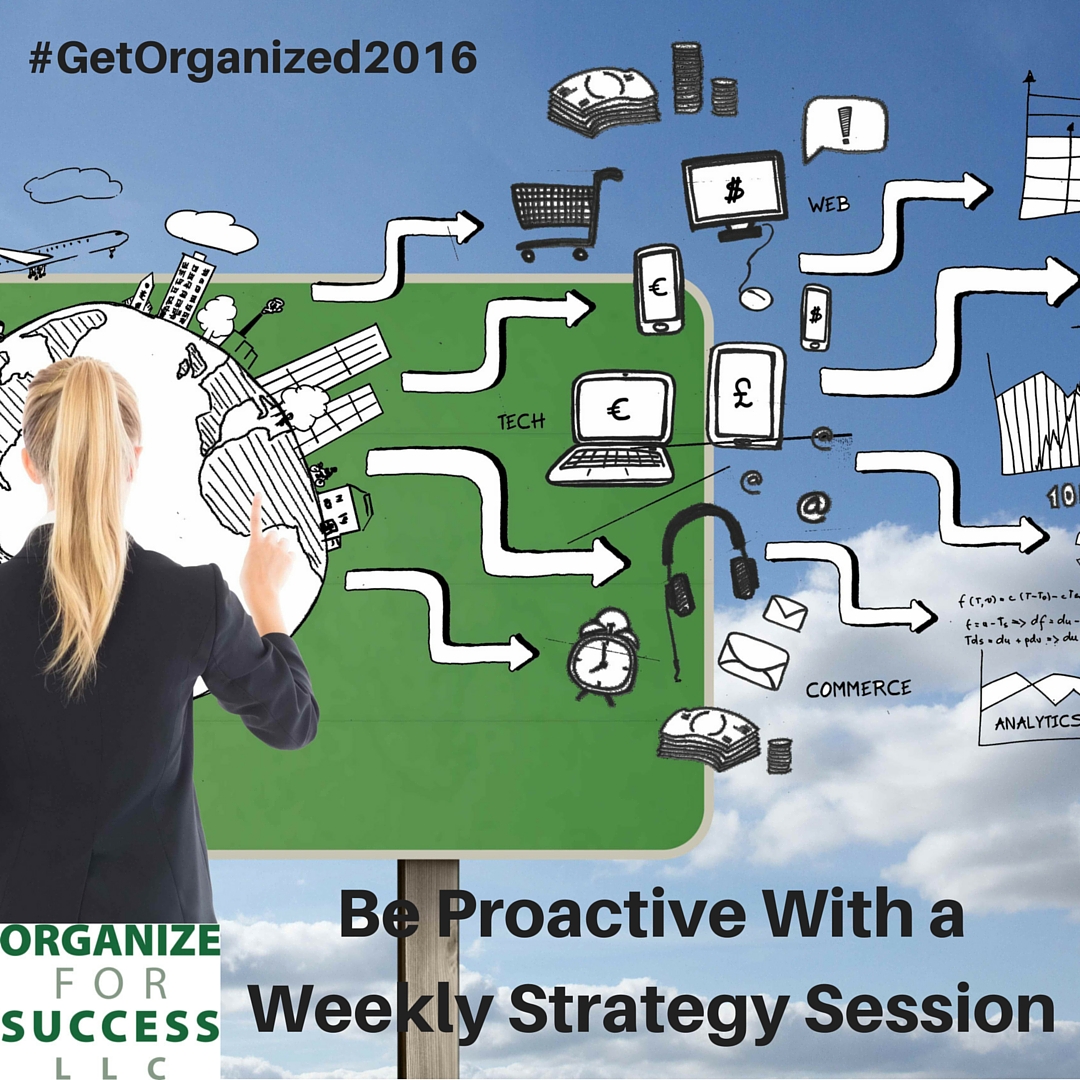
Be Proactive with a Weekly Strategy Session

If you have ever played or worked in athletics, you know there are many preparations that occur before each game, including scouting the opponent, preparing equipment and creating a game plan. Yes, during the game itself, there will be adjustments to the plan based off how the other team is playing, but coaches would never lead their teams into athletic competitions without creating a game plan prior to the start of that game. It is about proactively creating the direction in which you will proceed rather than starting in reactionary mode, not simply responding to the opponent's lead.

Make Every Minute Matter
This same philosophy is certainly applicable to your own work-life integration. Take control of your productivity by creating your own weekly strategy, where you plan specifically for how you'll address the following:

- Tasks - Evaluate which tasks from the week ending were left undone and should be carried forward. When will those incomplete tasks get done?

- Team Communications - Get in-depth updates, including what's working, what's not working and what needs attention.

- Client Communications - Catch-up on emails and calls. Then, reach out to schedule time with those who have been needing your attention; connect with those from whom you've not heard lately.

- Time Commitments - Review the upcoming week's commitments to ensure you are prepared for related tasks, leaving buffers for travel as well as unforeseen things to pop up.

- Development - Determine opportunities for personal and professional growth; what will move you towards your goals?

As you complete your weekly review of the ending week and plan for the one ahead, be strategic and map out a specific game plan for addressing all that needs your attention. With only 1,440 minutes in each day, we must make every minute matter.

How are you strategic in addressing each week's needs? Do you complete a weekly strategy session currently? If not, will you schedule that now for this Friday or sometime over the weekend?

Monday, January 4, 2016

Visualize Your Ideal 2016 to Make It Happen

One of the most successful methods for achieving a big goal is outcome visualization, where you create a detailed mental image of the desired outcome using all of your senses.

Succeed With Outcome Visualization
Today, take time to visualize your ideal 2016 so you can make it happen, paying attention to the details.

At the end of this year, how will you have spent your days? What will be your gross revenue? How many of what types of clients will have hired you? What did you start doing? What did you stop doing? What did you do more often than ever before?

Write your answers down; then, determine what needs to occur to make your vision a reality. What resources would help? What marketing efforts do you need to schedule? What types of networking do you need to incorporate in your upcoming plans? With whom do you need to interact more?

If you could use a little help getting started with outcome visualization, click here for Jack Canfield's step-by-step guide.

What is included in your vision for 2016? What needs to occur to make that vision a reality?

Sunday, January 3, 2016

Be Filled With Gratitude

I am blessed to live a full life, filled with many people, places, things, experiences and opportunties for which I'm very grateful, including my wonderful clients, my fabulous friends, having a roof over my head and not worrying about from where my next meal will come.

Gratitude can be very powerful! Whether via a note-taking app or paper journal, take time to jot down that for which you're grateful each day. Some days, you may be in a rush and have time to add one item to your list; other days, you may be able to go into more depth. Regardless of how many you list each day, the process of recognizing all your blessings will drive awareness, fuel gratitude and boost productivity.

Will you keep an electronic or paper list? What can you list as that for which you are grateful today?