Brought To You By Emily Parks
Productivity Consultant at Organize For Success, LLC...
Helping You Make Every Minute Matter!


Showing posts with label work-life integration. Show all posts

Tuesday, February 16, 2016

Is the Sum of Your Life's Parts Greater Than Each Alone?

As I was flipping through a catalog from Franklin Covey recently, I came across a quote that really reflects one of my productivity philosophies: "The sum is greater than the parts... When it comes to organizing your life, nothing happens in isolation. As you take an active role in planning your days, weeks and months, the choices you make influence each aspect of your life, multiplying and amplifying your results." It is only by proactively planning for each element of our lives that we are able to achieve our optimum overall outcome.

I love the quote of how TEAM stands for "Together, Everyone Achieves More", referring to the phenomenon how many different people working in harmony towards a shared goal will culminate in greater results than any individual working alone. Yet, that quote applies to much more than simply humans working together, including the power of work-life integration.

The are many elements encompassed in life: work, home, community and the private realm of mind, body and spirit. True harmony can come from integrating these various elements together. While the percentage of each day's 1,440 minutes fluctuates between elements as your priorities evolve, the return on investment of time in each element includes enhanced results for all the other elements in our lives. The benefits from one will boost the benefits experienced from others.

For example, by volunteering for a non-profit, we can learn skills that help in our businesses; likewise, managing our teams at work can help when leading our families at home.

According to Dictionary.com, synergy is "the interaction of elements what, when combined, produce a total effect that is greater than the sum of the individual elements", and this can benefit your productivity. Utilizing the synergy between elements of your life leads to better work - life integration and enables you to more thoroughly achieve your desired results.

How do you utilize work-life integration for greater productivity results? Are you regularly auditing your investment of time to ensure the way you're spending your time best reflects your priorities? Are there creative ways to achieve multiple goals with individual actions?

Sunday, January 31, 2016

Document Everything

Our ever-growing to-do lists, reference materials, resources, process outlines, checklists, websites to visit, shopping lists and much, much more... The amount of information we need to remember is constantly getting bigger and bigger. How can we possibly remember it all, let alone act upon any of it?!?

Where do you keep lists & references?
As we attempt to keep track of everything, it is important to remember that our brains are meant for strategic and creative thinking, not remembering things. Therefore, get it out of your head and document everything. Whether you choose a paper or electronic solution, do a data dump and collect all the information in a solution other than your brain.

While you probably use a calendar for dates to remember, an address book for contacts' information and a task management solution for your must-do items, where do you cull together everything else that is overflowing your brain? Do you prefer a paper notebook, a mobile app or something accessible everywhere?

I prefer to document everything in Evernote as it empowers easy reference while moving it all from to-do to done. Evernote gives me one username and password to access all information synced across my devices (smartphone, tablet, laptop, desktop as well as accessible via the Internet), it has unbelievable search capabilities to find exactly what I need when I need it, it allows for uploading an extensive list of different content types in various different ways, and it empowers me to easily share content with others to boost collaboration. Whether I'm retaining typed text, web clippings, photos of handwritten notes, checklists, audio or video recordings, bills from my service providers or documents, I can easily add those to my Evernote database; plus, when adding new content, there are so many ways to accomplish it: manually, scanning, IFTTT, emailing, FileThis and many more options.

As an Evernote Business Certified Consultant, I often post about ways to implement Evernote for your greater success, how you can utilize Evernote to boost productivity and ways Evernote will help alleviate your stress as you achieve harmony through work-life integration. To find these many helpful hacks and tidbits, simply search Evernote in the top, left-hand corner of this blog.

What tool do you use to remember everything? Your brain or an external place for dumping out all that information? Have you tried Evernote for culling it all together?

Friday, January 22, 2016

Take Time to Replenish Your Energy Reserves

In this day of "do, do, do" working and "give, give, give" living, it can be very challenging to retain enough energy. Replenishing our reserves can be imperative. There are habits you can work into each day that will aid replenishing your energy, and there are tactics to quickly boost your energy reserves as needed.

As part of the Simple Change Wellness team, I am well aware of the ramifications on my productivity from diminishing or replenished energy; however, like for many of you, taking action to improve my energy can be challenging.

Although what works best will be unique to you, here are a few examples to get you started:

- Listen to upbeat or calming music, singing and dancing to it.

- Ask for help, especially for clarity or to delegate.

- Create a vision board and refer to it often for inspiration.

- Spend time with those people who matter to you, whether in person, via video chat or over a phone call.

- Take a brisk walk, especially if you can get out in nature. Physical activity oxygenates blood cells; breathing outdoor air while absorbing vitamin D is invigorating. If you're tired, a short walk for about 15 minutes will generate about 90 minutes of energy.

- Appreciate what you have, who you are with and what lessons you have learned along the way; gratitude is so powerful, and acknowledging how each of us is blessed helps.

- Find something to make you laugh, like laughing at yourself.

- Feel compassion for yourself as well as those around you, finding forgiveness for everyone's shortcomings.

- Eat well... Healthy foods spread throughout the day fuel our energy, especially when we increase our intake of magnesium and antioxidants. I really enjoy a power shake for a snake during the day: Put 1 small, ripe banana that's been sliced, 2 tablespoons of creamy peanut butter and 1 tablespoon of honey in a blender until smooth; then, add 1 cup of cold milk and blend until foamy.

- Stay hydrated... Keep a water bottle with you at all times and drink from it frequently during the day.

- Have something to look forward to, whether you are planning for an upcoming vacation or bought tickets to a special event. That feeling of anticipation and excitement can boost your energy.

- Meditate... Sitting quietly to relax your mind will relax your entire body and bring oxygen to your cells. Apps like Calm, Buddhify and OMG I Can Meditate make it easier to get started.

What tactics do you use currently to replenish your energy reserves? Are you feeling a little low on energy today? If so, which of these can you give a try right now?

Thursday, January 21, 2016

Automate Your Computer Backup

For most folks, it is not a matter of "if" but "when" regarding whether your computer will crash, get a massively destructive virus or be destroyed by a natural disaster. Instead of worrying about your data, take action. You can be prepared with automated, remote storage, which eliminates having to plug anything in for backing up your information and provides offsite backup in a remote area with totally different natural disasters. Compare current offerings from Backblaze, Carbonite, CrashPlan and Mozy to see from whom you can get the best deal; then, after creating your account, download your choice's software from its website, follow the instructions for setting the parameters of your automated backup and relax because your information is being secured as you continue working. There's nothing to remember, but I do recommend occasionally checking that your set-up is functioning properly, which you can plan for once a month or so.

How do you currently backup your data? Might you implement one of the tools I've mentioned here?

Sunday, January 17, 2016

Sharing is Caring

Theodore Roosevelt famously said, "People don't care how much you know until they know how much you care." In today's relationship-driven society, where people are said to do business with folks they "know, like and trust", building that foundation is so integral for one's success. Such an endeavor takes time and energy but is paramount for connecting with others.

I have found the basis for building many of my most valued relationships stems from the understanding that "Sharing is caring", whether I am sharing information, time, a listening ear, a helping hand, a little bit of happiness or whatever might be of value to the person with whom I am sharing. It is about reaching out and creating a connection.

There are so many options for what can be shared with those about whom you care, but here is a sampling of ideas to consider:

- book, eBook or article you've written that might be helpful

- someone else's content that might be of interest to that person

- flowers to brighten up that person's office or home

- a handwritten note to convey your appreciation or share news

- time in-person over coffee, tea, frozen yogurt or a cocktail

- a phone call to catch-up and see how that person is doing

What do you share with those about whom you care to deepen the connection? How can you take action today to share something new and different with someone?

Friday, January 15, 2016

Delegate or Automate When You Can

As time is a limited resource, it is not possible for any one human-being to do everything on his or her own... There simply are not enough minutes in the day. Still, since our inability to get it all done alone does not eliminate the never-ending to-do list, it is imperative to come up with alternatives, particularly until cloning becomes feasible for us all or we get our Inspector Gadget tools.

When evaluating your to-do list, consider what requires your unique skill set versus what can be accomplished by someone else; alternatively, consider what can be done more quickly or more thoroughly by another individual. Delegate or automate when you can. In any instance that you delegate or automate the completion of a task, you open up time in your schedule to allocate elsewhere.

Resources for delegation are not limited to existing members of your team. There are endless options for delegating many different types of tasks via Help Tap, Upwork, Fancy Hands, Fiverr, Guru, Moonlighting, Task Rabbit, Thumbtack and 99Designs. These websites include options for all instances of budgetary constraints and many skill sets. Likewise, consider automation as delegating to a computer, and evaluate the many options for automating tasks to best fulfill your needs. If This Then That, Podbox, Zapier and social media managers, like Buffer, Edgar, Falcon Social, Hootsuite, SocialOomph or Sprout Social, are all excellent for automation. Once you know which of your to-do items can be delegated or automated, find the resource to do so.

Delegation and automation are powerful tools for getting more done in less time and, thereby, boosting your productivity while maintaining your peace of mind and not missing opportunities.

What are some tasks on your to-do list that could be delegated or automated? Which of these tools might you be able to implement in your own productivity toolbox?

Wednesday, January 13, 2016

Regularly Perform a Time Audit to Avoid Burnout

According to Dictionary.com, burnout is "fatigue, frustration or apathy resulting from prolonged stress, overwork or intense activity". Often times, this burnout directly results from a lack of alignment between your actions and your goals or priorities. Your health depends on taking action to avoid such burnout.

Since burnout is usually due to a misalignment between your goals and your daily actions, regularly complete a time audit to verify your actions are in alignment with your goals, priorities and values. For example, are you attending meetings you don't really need to be in just so you can be seen there? Verify meetings you attend have a structured agenda, set goals and a need for input from all there. Invest your time wisely to focus on what's most important as each day has only 1,440 minutes.

Our individual circumstances change at different stages in our lives so be ready for the percent of each day devoted to each element of your life to vary from time to time. Some days will have a greater investment of time in work while others will focus more time on community; keep your focus fluid as needs shift between work, home, community or society and the private realm of mind, body and spirit. Still, as emphases shift, focus all actions on your goals.

How do you monitor the ways you're investing your time to make sure they align with your goals, priorities and values? Will you implement a time audit to achieve better work-life integration and avoid burnout?

Monday, January 11, 2016

Delete and Discard Can Be Our Friends

When you look at the space in which you work, do you see clutter and piles? The more we have, then the more we have to sift through to find what we need when we need it, and those wasted moments can be better invested with other activities.

Always remember that delete and discard can be our friends! Whether email, paper, electronic documents or physical items, keep only what is accurate, applicable, useful or bringing you joy, and you'll better utilize your workspace as a tool in your productivity toolbox.

If you are struggling in deciding whether to keep something, consider what would be the worst-case results if you discarded it but needed it later. Are there legal ramifications? Can the content be easily found online or recreated? There is nothing wrong with keeping things, but I encourage you to be strategic (and selective) about what you choose to fill your workspace.

What is your current process for deciding what to keep or discard? Once you've reviewed everything in your space, how will you maintain such order, including an ongoing review of what you have kept as well as what's new?

Sunday, January 10, 2016

Take Time to Send Hand-Written Notes

Today's busy professionals can benefit from productivity hacks that make the most of the time we have each day. Each day's 1,440 minutes go by quickly so it is imperative to make every minute matter. However, at times, there can be additional value in taking a few extra minutes to distinguish ourselves from others.

Since it is so easy to shoot off an email or text, be different... Take time to send hand-written notes.

There are many instances in which a hand-written note is a great idea, such as the following:

- to say thanks for someone's support or extra effort

- to congratulate someone on an achievement or new job

- to share an article you think might be useful or of interest

- to let someone know you have been thinking about him or her, whether out of the blue or during a difficult time for that person

- to acknowledge a special event or holiday, particularly less acknowledged holidays like the start of a new day, Valentine's Day, the anniversary of working with a client or someone's birthday

My only caveat in recommending hand-written notes is that some folks like to hold onto every note they have ever received, which creates additional clutter. Sending and receiving hand-written notes can be great; yet, you might want to include a message that encourages the recipient to recycle the note after reading.

Do you like sending or receiving hand-written notes? In what instances do you find them most valuable?

Saturday, January 9, 2016

Which of Your Tasks Can You Do in 10 Minutes?

Throughout your day, as you move seamlessly between time commitments, free blocks of time do not regularly appear. However, in those magical moments when a meeting wraps up early or you are waiting for your next appointment, you definitely do not want to waste those precious moments determining what can be done within the available timeframe. 

If circumstances gift you with 10 minutes of free time but you spend 5 minutes determining what can be done within the available time, you lose time to get more done. Alternatively, if you keep a list readily available of which to-do items can be completed in a 10-or 30-minute time slot, you are ready to hit the ground running when such blocks of time become available.

As you are documenting your running list of to-do items, denote how long you anticipate each taking, particularly for those that fit within smaller blocks of time. When free time occurs, you can glance at your list to see which of the denoted times for completing listed tasks will fit within what time is available.

Do you know which of the items on your running to-do list can be completed within 10 minutes? If not, for which tasks can you add an estimated time to complete it?

Friday, January 8, 2016

End Each Day with the Next in Mind

With each morning laying the foundation for how things will go throughout that day, the importance cannot be overstated for anything you can do the night before to help remove unnecessary actions from your morning routine and streamline processes for getting ready. Be proactive and better make every minute matter.

Boost productivity by ending each day with the next in mind. Here are some ideas to help:

- Plan what you'll need for the next day's schedule. If you are headed directly to a meeting from your home first-thing in the morning, do you have any files or notes you'll need ready to take with you as you walk out the door? Where are your wallet and keys?

- Verify the weather forecast and prepare your next day's outfit. Make sure you have all the appropriate undergarments and accessories that you will need. Are your clothes ironed? Do you need to shine your shoes? Pay attention to all applicable details.

- Think through the details of what you'll eat for breakfast. If you eat cereal each morning, maybe you set your bowl and spoon beside the cereal box on your countertop. If your coffeemaker allows for programming a start time, have you filled it with coffee and programmed in when it is to start?

- Prepare your lunch plans. If you take your lunch, go ahead and make it, but leave a note beside your car keys to remember to retrieve it from the kitchen. If you go out for lunch each day, think through a location of preference and check its online menu.

- Make sure your vehicle has gas. How often are we racing out the door, running a few minutes late, and realize our low fuel light is on immediately upon turning on the ignition, when we definitely don't have time to stop by the gas station?!? If you take care of that the evening before, it is one less issue to potentially create morning madness.

- Finish with a tablespoon of unsweetened almond butter. This will maintain anyone's blood sugar overnight so you wake up more refreshed. I've also heard that melatonin can help, and MidNite is a quality option for a drug-free sleep aid.

What actions do you take at the end of each day to ensure the next day starts the way you want? Are there any items listed here you'll incorporate into your daily habits?

Thursday, January 7, 2016

Jump-Start Your Morning

How you start each day can lay the foundation for how things will go all day long. When you oversleep and race frantically out the door, it can make you stressed and frazzled throughout your entire day. Alternatively, if you have a set morning routine that builds up your energy, keeps you happy and smooths your way out the door with time to spare, that positive energy can fuel your day.

Jump-start each morning with these 3 simple steps:

- Remove unnecessary actions from your morning routine. Do you really need to empty the dishwasher or pick-up your child's toys? If the task is not getting you closer to walking out the door, at what time can it be scheduled for doing later?

- Streamline your processes for getting ready each day. Is there a breakfast option which is easier to prepare that you can have daily? Might you be able to simplify styling your hair or how you apply make-up?

- Use hacks to boost your energy from the start of each morning. What can you do to get up and moving immediately? Would there be any early workout you could start or should you try the 7 Minute Workout app? Do you have an upbeat playlist in your music that you could incorporate in your morning routine? Plus, drinking a tall glass of water with a squeeze of lemon juice will certainly improve your morning energy level.

How do you regularly start your day? Have you found success with anything I've shared? Which of these will you be incorporating in your upcoming mornings' routine?

Wednesday, January 6, 2016

Always Complete Your Daily Wrap-Up

As we discussed in yesterday's post, it is imperative to create a weekly strategy so you are proactively taking control of how your time is invested; however, we live in the real world, and things happen to derail even the best laid plans. You get pulled into an unexpected project, an emergency arises, a colleague calls in sick or your client desperately needs your help immediately.

To stay on track amidst all the curveballs that life will throw your way, end each day with your daily wrap-up, where you address these items:

- Communications: Get updates from team members and "hot prospects", both new and returning; touch bases to increase your awareness of what is happening while keeping you in the other folks' awareness.

- Tasks: Review that day's to-do list; determine which incomplete items will be completed when. Ready the next day's "must-do" list, remembering that a list of 3-5 items will be realistic and allows you to hit the ground running.

- Time: Evaluate your schedule for the next day, verifying that you're prepared for it all. If not yet ready, when will you allocate time for those preparations?

- Workspace: Tidy up... File new items and put that day's work back into each item's home.

- Successes: Celebrate all you've accomplished in the day that's ending. If you got out of bed, you accomplished something!

- Gratitude: Make note of that for which you are grateful at the end of each day, whether one item or a list of things.

How do you resolve on the loose ends at the end of each day? What is your response whenever your weekly strategy is thrown off course? Which of the items in this daily wrap-up do you find most valuable? What can you start today?

Tuesday, January 5, 2016

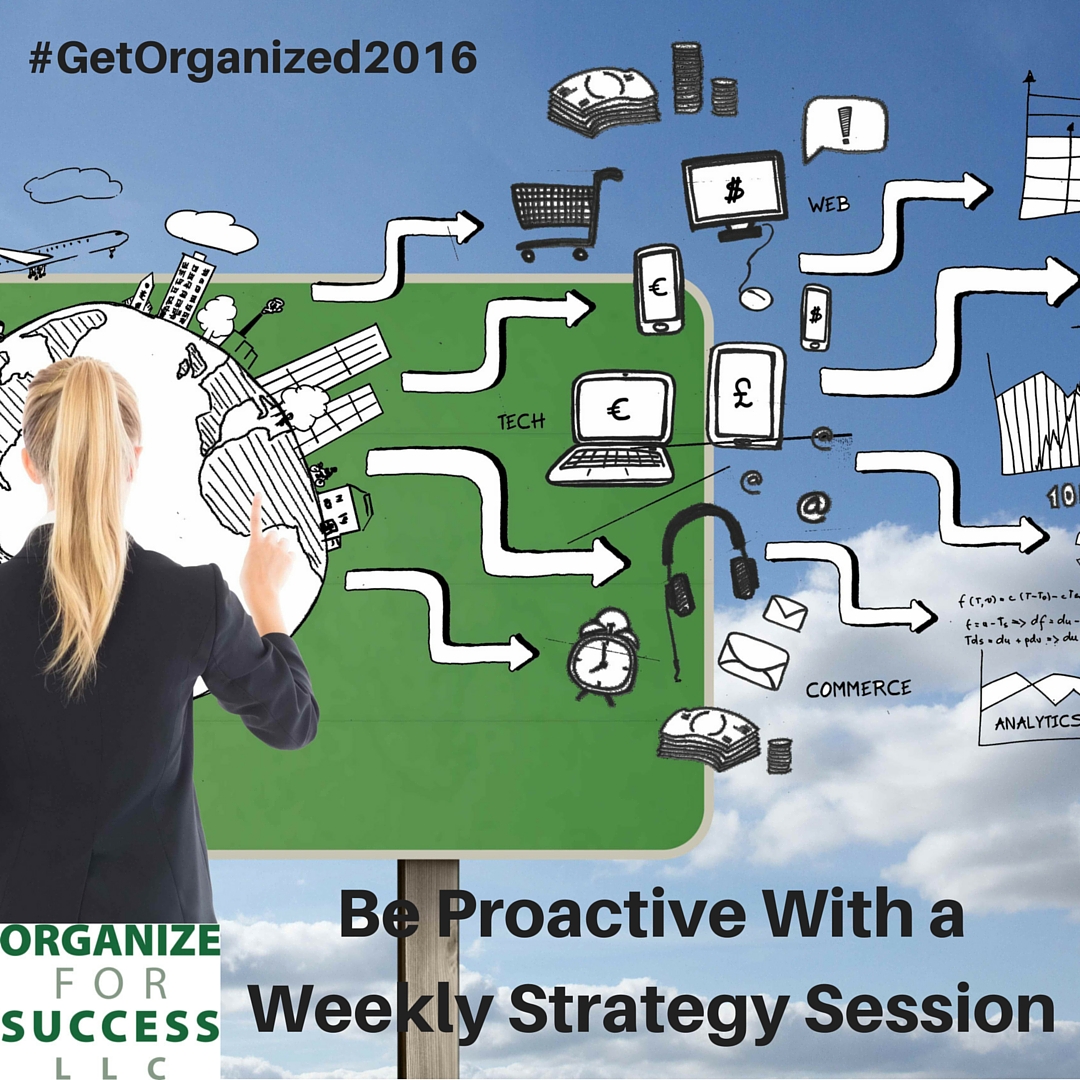
Be Proactive with a Weekly Strategy Session

If you have ever played or worked in athletics, you know there are many preparations that occur before each game, including scouting the opponent, preparing equipment and creating a game plan. Yes, during the game itself, there will be adjustments to the plan based off how the other team is playing, but coaches would never lead their teams into athletic competitions without creating a game plan prior to the start of that game. It is about proactively creating the direction in which you will proceed rather than starting in reactionary mode, not simply responding to the opponent's lead.

Make Every Minute Matter
This same philosophy is certainly applicable to your own work-life integration. Take control of your productivity by creating your own weekly strategy, where you plan specifically for how you'll address the following:

- Tasks - Evaluate which tasks from the week ending were left undone and should be carried forward. When will those incomplete tasks get done?

- Team Communications - Get in-depth updates, including what's working, what's not working and what needs attention.

- Client Communications - Catch-up on emails and calls. Then, reach out to schedule time with those who have been needing your attention; connect with those from whom you've not heard lately.

- Time Commitments - Review the upcoming week's commitments to ensure you are prepared for related tasks, leaving buffers for travel as well as unforeseen things to pop up.

- Development - Determine opportunities for personal and professional growth; what will move you towards your goals?

As you complete your weekly review of the ending week and plan for the one ahead, be strategic and map out a specific game plan for addressing all that needs your attention. With only 1,440 minutes in each day, we must make every minute matter.

How are you strategic in addressing each week's needs? Do you complete a weekly strategy session currently? If not, will you schedule that now for this Friday or sometime over the weekend?

Monday, January 4, 2016

Visualize Your Ideal 2016 to Make It Happen

One of the most successful methods for achieving a big goal is outcome visualization, where you create a detailed mental image of the desired outcome using all of your senses.

Succeed With Outcome Visualization
Today, take time to visualize your ideal 2016 so you can make it happen, paying attention to the details.

At the end of this year, how will you have spent your days? What will be your gross revenue? How many of what types of clients will have hired you? What did you start doing? What did you stop doing? What did you do more often than ever before?

Write your answers down; then, determine what needs to occur to make your vision a reality. What resources would help? What marketing efforts do you need to schedule? What types of networking do you need to incorporate in your upcoming plans? With whom do you need to interact more?

If you could use a little help getting started with outcome visualization, click here for Jack Canfield's step-by-step guide.

What is included in your vision for 2016? What needs to occur to make that vision a reality?

Saturday, January 2, 2016

Build a Solid Foundation for Your Greater Productivity

For many people, getting organized tops the list of new year's resolutions. All around us, there are people talking about what works for them and experts sharing tips to help. It can be very easy to say "I'll do that" or "That would be great for me" to all the ideas you hear; however, in my experience, trying too many things at once leads to failure and will discourage future efforts.

Instead, think about achieving your goals like eating an elephant. How would you eat an elephant? I have always heard the only way to eat an elephant is one bite at a time, which is the same way I look at attacking any project... Bit by bit by bit.

Attempt any productivity and organization tidbits one at a time, not all at once, and develop habits slowly so they really stick. Adopting new ways of doing things and making changes can be difficult, but it is much easier when undertaking smaller chunks instead of an overhaul all at once.

Once you've mastered one change, it is a much better time to move on to the next change than seeking to make multiple changes at the same time. Plus, each of those changes is rarely as challenging in reality as we envision it will be in our minds.

Which element of your productivity practices or workflow processes do you want to change first? Have you tried to improve previously and struggled due to attempting too many changes at once? I'd love to hear your experiences!