Brought To You By Emily Parks
Productivity Consultant at Organize For Success, LLC...
Helping You Make Every Minute Matter!


Showing posts with label weekly strategy session. Show all posts

Monday, January 29, 2018

Practice the Power of One

Although Three Dog Night might've wanted to convince folks that one is the loneliest number, I believe wholeheartedly that one is the most powerful number for productivity. There can be power in the masses, meaning a team collaborating in harmony makes greater progress than an individual; however, when it comes to certain organizing tools, it's more impactful to practice the power of one. When you have one place to look for information, one place to update content and one place from which data feeds, it is easier to quickly find what you need when you need it, keep content updated as it changes and verify information is processing correctly. Here are a few examples:

  • Address Book - For contacts' names, phone numbers, emails and snail mail addresses as well as any notes gathered via interactions with that person, keeping everything centralized within one system better enables it will stay up-to-date and be quickly accessible whenever or wherever needed, rather than having the business card left elsewhere or the phone number locked in another tool. It is best to have your solution sync across devices, meaning you don't have to manually enter details' changes on computers as well as mobile devices.
  • Calendar - Whether it's paper or electronic, a single place to track all time commitments (personal and professional) makes it less likely that appointments will be forgotten or you'll double-book yourself. If you choose an electronic option, you can still benefit from the power of one principle with various calendars for different elements of life, like one shared with your spouse, one shared with folks at work and one for volunteer commitments, as long as you have a viewing option to see everything at once, letting conflicts be visible easily.
  • Cloud-Based, Automated Back-up - Computers crash. Fires can destroy all your devices. Emergencies happen. It is with an automated, remote storage of all data from your hard drive that you can truly be prepared for anything. There is a difference between an online file repository and a cloud-based, automated back-up, which means both are necessary, and it's important to be strategic in managing electronic files. Unlike a hard-drive that you attach to your computer for backing up data, a cloud solution isn't at risk of natural disasters in your physical proximity, doesn't require you remembering to hook it up for activating the back-up and has multiple points at which your data storage is duplicated as well as protected.
  • "Data Dump" of Information - Human-beings are inundated daily with information, like meeting notes, ideas, reference articles, checklists, process steps, voice mails, blog posts, emails, texts and inspirations. Since our brains are meant for thinking, not remembering, it's important to document everything. Keeping it all in one place limits the places you must check when trying to find whatever's needed. 
  • File-Naming Structure - Whether paper files, electronic documents or saved emails, having each folder and individual file follow the same naming conventions will allow you to know what goes where and more easily retrieve each item later. If you have to ask "where should I file this?" when assigning a home to newly received or created content, how will you ever be able to find it later? Make sure you have enough folders for all the content to be retained while not having so many folders that any one item could go into more than one; then, keep your file-naming structure simply while avoiding "miscellaneous" so it's easy to replicate across the various retention platforms.
  • Password Manager - There's no doubt that our list of websites and software solutions requiring logins is continually growing, and we must protect ourselves with better password management. Listing all usernames and passwords in one place saves time as we're frantically trying to get logged in, and an electronic solution is more secure, allows easier access while on-the-go, creates more secure passwords, can alert you automatically when any site has been hacked and works cross-platform so you always have the right login information, no matter which device is being utilized to access your account.
  • Strategy for Attacking Priorities - Proactively create the direction in which you will proceed each week rather than living in reactionary mode by completing a weekly strategy session to develop a game plan for tasks, communications, time commitments and development opportunities in advance. Use your weekly strategy to ward off time stealers and others priorities since knowing where you're headed helps in getting there. Then, implement a daily wrap-up to stay on track throughout the week, avoiding deviations from curveballs that life will throw your way while addressing what matters most.
  • To-Do List - When jotting tasks down in different notebooks, on meeting agendas, using sticky notes atop your desk or on the napkin you grab in the drive-through line, it's more difficult to know what needs to be done when. Alternatively, keeping all the action items needing your attention in one place makes it more likely they'll get completed, aides in prioritizing and allows for divvying out must-do items across each day of the week. If you opt for an electronic task manager app, it adds reminders, easier carryover, recurrences and useful integrations.

Where do you see the power of one boosting your productivity currently? How can you streamline your toolbox to have one tool for each listed function? 

Tuesday, January 9, 2018

Stay on Track with a Daily Wrap-Up

Are you familiar with the quote "the best laid plans of mice and men often go awry"? This is a common experience for people as they strive to boost productivity. The week starts with a plan, something shifts, and that initial plan seems to no longer fit. Maybe a client has an urgent, unexpected issue arise and needs your time to get the situation resolved. Or a team member calls in sick, leaving you to cover the tasks that can't fall through the cracks. Perhaps one of your employees needs direction to meet a deadline, pulling you away from your must-do list to answer questions.

There are two ways to respond: either feel like the week is lost or make adjustments to get back on track. I find daily adjustments enable achieving my priority goals and fuel my desired results.

Completed at the end of each day, the following checklist enables the necessary adjustments and better empowers staying on track:

  • Communications - Get end-of-day updates from appropriate team members, touching bases to drive awareness and get everyone on the same page; think outside the box to include all team members, like employees, subcontractors, vendors, family members, roommates, volunteer committee members and more. Touch bases with new and returning "hot prospects" to increase your awareness of what is happening while keeping you in the other folks' awareness. Verify you're up-to-date processing received emails and following up on voice mail.
  • Tasks - Review your must-do list from the day that's ending and look over the next day's anticipated to-do list. Are all important tasks included that need attention to meet impending deadlines? If something wasn't completed today, determine at what point in the next few days time can be allocated for completing those carryover tasks. It is realistic to plan for fulfilling 3-5 actions on any given date, and knowing beforehand which are your must-do items for the next day will allow you to hit the ground running when you return to work.
  • Time Commitments - Evaluate your schedule for the next day and verify that you are prepared for everything scheduled. If you are not prepared, when will that preparation occur? Does your calendar include buffers and time to get where is needed?
  • Space - Whether you're in 4 walls, an open office space, a vehicle or working from a bag, tidy up your workspace. File new items and put that day's work back into each item's home, creating a blank slate for the next day. Make sure what you need for the next day's activities is ready and accessible.
  • Successes - We live in a do, do, do society, meaning we don't necessarily take time to reflect on meeting the goals for which we strive. Instead, each day, celebrate all you've accomplished in the day that's ending. If you got out of bed, you accomplished something, and acknowledging that is motivating. Stop the monotony of simply getting things done, and acknowledge what you've successfully completed to encourage continued productivity. Make sure you take time to celebrate daily successes, no matter how large or small.
  • Gratitude - As there is a vast amount of research regarding the many ways gratitude improves productivity, use the power of gratitude to drive your daily productivity. End each day with gratitude, and denote that for which you are grateful each day. Don't stop with simply thinking of that for which you are grateful; actually say it out loud or document in a gratitude list at least 1 thing for which you feel grateful every day.
What is your experience? Do you take time at the end of each day to properly wrap-up the day that's ending as well as plan for the next day? What successes can you share from practicing this habit? On the flip side, what issues have arisen when you've been unable to regroup daily and end each day getting back on track? What aspects of this checklist can you start implementing today?

Wednesday, January 6, 2016

Always Complete Your Daily Wrap-Up

As we discussed in yesterday's post, it is imperative to create a weekly strategy so you are proactively taking control of how your time is invested; however, we live in the real world, and things happen to derail even the best laid plans. You get pulled into an unexpected project, an emergency arises, a colleague calls in sick or your client desperately needs your help immediately.

To stay on track amidst all the curveballs that life will throw your way, end each day with your daily wrap-up, where you address these items:

- Communications: Get updates from team members and "hot prospects", both new and returning; touch bases to increase your awareness of what is happening while keeping you in the other folks' awareness.

- Tasks: Review that day's to-do list; determine which incomplete items will be completed when. Ready the next day's "must-do" list, remembering that a list of 3-5 items will be realistic and allows you to hit the ground running.

- Time: Evaluate your schedule for the next day, verifying that you're prepared for it all. If not yet ready, when will you allocate time for those preparations?

- Workspace: Tidy up... File new items and put that day's work back into each item's home.

- Successes: Celebrate all you've accomplished in the day that's ending. If you got out of bed, you accomplished something!

- Gratitude: Make note of that for which you are grateful at the end of each day, whether one item or a list of things.

How do you resolve on the loose ends at the end of each day? What is your response whenever your weekly strategy is thrown off course? Which of the items in this daily wrap-up do you find most valuable? What can you start today?

Tuesday, January 5, 2016

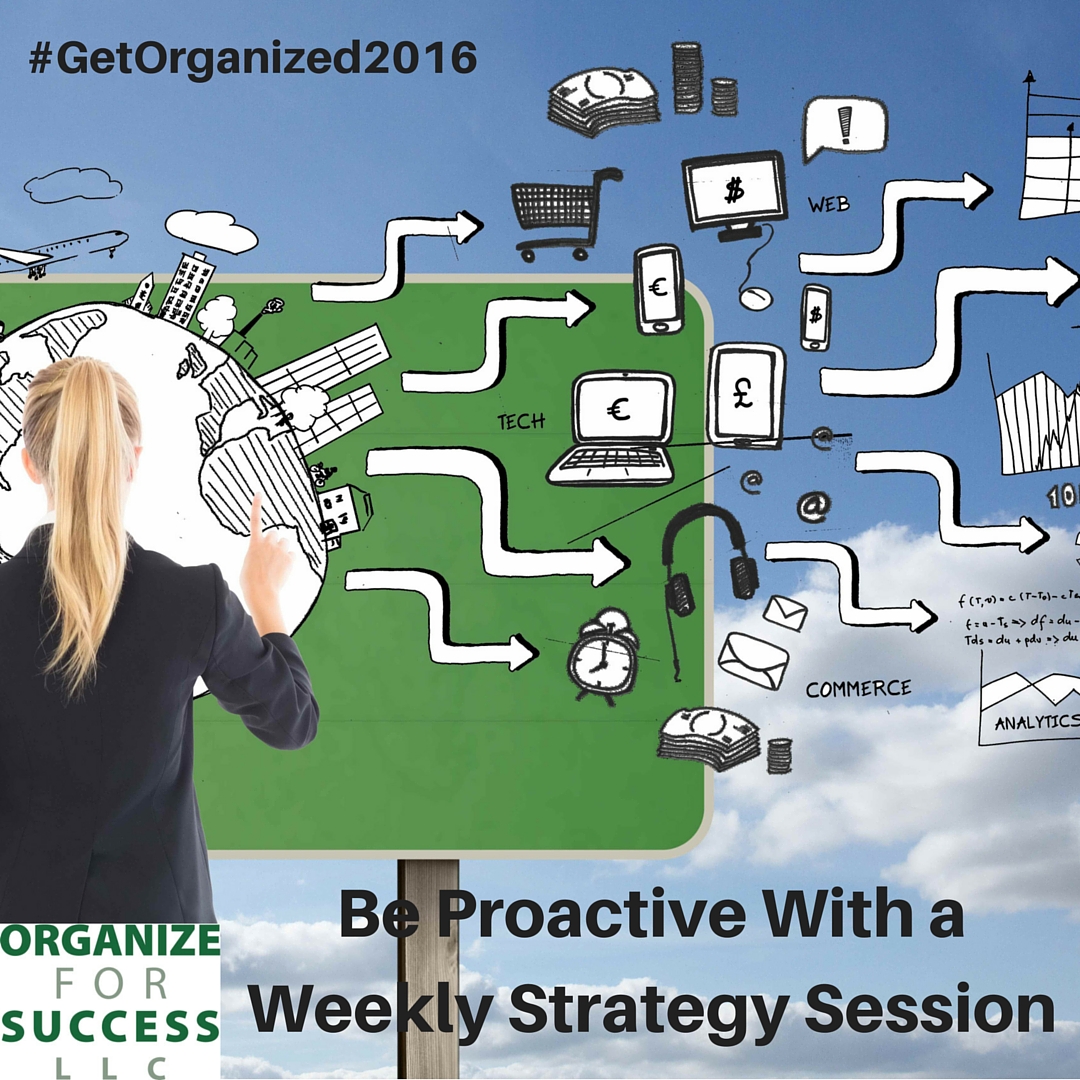
Be Proactive with a Weekly Strategy Session

If you have ever played or worked in athletics, you know there are many preparations that occur before each game, including scouting the opponent, preparing equipment and creating a game plan. Yes, during the game itself, there will be adjustments to the plan based off how the other team is playing, but coaches would never lead their teams into athletic competitions without creating a game plan prior to the start of that game. It is about proactively creating the direction in which you will proceed rather than starting in reactionary mode, not simply responding to the opponent's lead.

Make Every Minute Matter
This same philosophy is certainly applicable to your own work-life integration. Take control of your productivity by creating your own weekly strategy, where you plan specifically for how you'll address the following:

- Tasks - Evaluate which tasks from the week ending were left undone and should be carried forward. When will those incomplete tasks get done?

- Team Communications - Get in-depth updates, including what's working, what's not working and what needs attention.

- Client Communications - Catch-up on emails and calls. Then, reach out to schedule time with those who have been needing your attention; connect with those from whom you've not heard lately.

- Time Commitments - Review the upcoming week's commitments to ensure you are prepared for related tasks, leaving buffers for travel as well as unforeseen things to pop up.

- Development - Determine opportunities for personal and professional growth; what will move you towards your goals?

As you complete your weekly review of the ending week and plan for the one ahead, be strategic and map out a specific game plan for addressing all that needs your attention. With only 1,440 minutes in each day, we must make every minute matter.

How are you strategic in addressing each week's needs? Do you complete a weekly strategy session currently? If not, will you schedule that now for this Friday or sometime over the weekend?

Friday, July 31, 2015

Use a Weekly Strategy Session to Organize for Success

It's Friday afternoon, and, as you look back on the week wrapping up, how productive are you feeling? Usually, when we come into the week with a game plan, we are able to address what's important, rather than getting caught up in putting out fires or handling what's urgent; we tackle our priorities. Yet, if we wait until we walk into the office to determine what must be done, the phone rings, we get an emergency email or someone stops by to ask for our time; then, we're pulled in totally different directions, not meeting our goals.

I urge you this afternoon (and every Friday afternoon going forward) to take time for a Weekly Strategy Session, where you wrap up the week that's ending and properly plan for the week ahead. Going beyond prioritizing our schedules so we're scheduling our priorities can be extremely powerful. It's amazing what being proactive can do for achieving important objectives!

Work through each item below to properly plan the week ahead:

  • Carryover Tasks - Evaluate which of the ending week's tasks were completed, determining what's left undone and to when those undone tasks must be carried forward.
  • Client Communications - If there are people with whom you've been meaning to connect, call or email to schedule a convenient time to chat in the following week. Likewise, connect with clients you've done business with previously but haven't heard from in awhile; remind them of how you enjoyed working with the in the past, suggest new ways you can help, share what's new in your organization and pass along articles you feel might be helpful to them.
  • New Tasks - Schedule time to complete any tasks moving towards their deadlines, making sure each what that must be done has a when for moving it from "to-do" to "done".
  • Time Commitments - Review next week's commitments to ensure you're prepared for related tasks and appointments, making sure there is time for preparation and travel to each.
  • Development Options - Determine opportunities for personal and professional growth, scheduling what will move you towards your goals and keep your priorities in focus.
  • Strategy - Map out a specific game plan for addressing the upcoming week's task and time commitments, empowering you to start each day with only 3-5 "must do" items.

Especially when you first start implementing the Weekly Strategy Session, set a timer. Knowing you have a certain amount of time in which to complete this checklist will better ensure your planning doesn't run longer than necessary. Plus, shorter times lead to an extra burst of energy to get more done in less time.

No football, basketball or baseball team would go into a game without scouting the opponent and creating a game plan. Similarly, you should never go into a week without properly planning, evaluating what's ahead and determining how you will address all that you must handle. It is with a Weekly Strategy Session that busy professionals can be organized for success.

Share your story... Do you take time at the end of each week to properly plan the week ahead and proactively address your priorities? Alternatively, what issues have you encountered when you haven't been able to plan adequately?