As defined online, gratitude is "the quality of being thankful; readiness to show appreciation for and to return kindness", stemming from the Latin word for "pleasing" or "thankful" and providing great emotional fuel.
Gratitude can be a very powerful tool in your productivity toolbox. As Lifehack explains, "Gratitude is a frame for reality, which enables us to align with the good in the world as well as the evolutionary progress of the human race." Research shows how gratitude improves productivity in many different ways: higher energy, alertness, enthusiasm, determination and attentiveness; lower stress, anxiety and depression; improved sleep and decreased illness.
According to HubSpot, there's a causal chain, where "Writing down what you're thankful for increases happiness; happiness increases productivity." Thus, documenting that for which you are grateful can be one of the easiest, least expensive and most effective ways to boost productivity. Yet, it requires a habit of documenting, not simply thinking about, that which makes you grateful.
Whether via your mobile devices Notes application, an electronic journal, a log of videos or a paper notebook, take time to jot down that for which you're grateful each day. I prefer to incorporate this in my daily wrap-up, ending each day reflecting upon the day that I just lived, but it's most important to choose whatever time of day is something you can maintain. Some days, you may be in a rush and have time to add only one item to your list; other days, you may be able to go into more depth and roll off several items for which you are grateful. Regardless of how many you list each day, the process of recognizing all your gifts will drive awareness, fuel gratitude and increase productivity.
What tool will you use to document your gratitude? Will it be electronic or paper? What can you include as today's gratitude list?
Showing posts with label new year. Show all posts
Friday, January 12, 2018
Friday, January 5, 2018
Be Proactive with a Weekly Strategy Session
Imagine it's Friday afternoon and you're preparing to walk out the door for the weekend. Looking back on the work week that's ending, how accomplished are you feeling? Did you effectively address what was important for work, home, your community and yourself? Or did you get pulled into others' priorities, spend your week putting out fires and neglect your goals?
If you feel less successful than you'd like, take steps to better address what matters most in upcoming weeks.
Those who have ever played or worked in athletics know there are many preparations that occur before each game, including scouting the opponent, preparing equipment and creating a game plan. Yes, during the game itself, there will be adjustments based off how the other team plays, but coaches would never lead their teams into athletic competitions without creating a game plan beforehand. It is about proactively creating the direction in which you will proceed rather than simply reacting to what's thrown your way, and the same philosophy applies to addressing your priorities for work, home, your community and making yourself the best possible.
Take control of your productivity by creating your own weekly strategy, which is a specific game plan for how you'll address your priorities in each of the following ways:
It is less important when you complete this process as compared to whether or not you get it done at all; many like to wrap-up the week with a weekly strategy session on Friday, Saturday or Sunday, but choose which works best for your unique situation.
Be strategic and map out a specific game plan for addressing all that needs your attention. Keep in mind each of the elements for work-life integration: work, home, community or society as well as the private realm of mind, body and spirit. As each of these elements is a layer of life with rotating levels of emphasis, focus on how you can best invest the upcoming week's 168 hours to address the current priorities within each realm of your life.
Especially when you first start implementing the weekly strategy session, set a timer. Knowing you have a certain amount of time in which to complete this checklist will keep you focused and better ensure your planning doesn't run longer than necessary.
Do you take time at the end of each week to properly plan the week ahead and proactively address your priorities? How does this equip you for greater productivity? On the flip side, what issues have you encountered when you haven't been able to plan adequately before starting your week?
If you feel less successful than you'd like, take steps to better address what matters most in upcoming weeks.
Those who have ever played or worked in athletics know there are many preparations that occur before each game, including scouting the opponent, preparing equipment and creating a game plan. Yes, during the game itself, there will be adjustments based off how the other team plays, but coaches would never lead their teams into athletic competitions without creating a game plan beforehand. It is about proactively creating the direction in which you will proceed rather than simply reacting to what's thrown your way, and the same philosophy applies to addressing your priorities for work, home, your community and making yourself the best possible.
Take control of your productivity by creating your own weekly strategy, which is a specific game plan for how you'll address your priorities in each of the following ways:
- Carryover Tasks - Evaluate which of the tasks you'd planned to do during the week that's ending were actually completed; determine what's left undone and when those undone tasks can be rescheduled. Be honest with yourself about what you are actually willing to do. If not you, then who can accomplish what needs to get done? What can you delegate? Does each incomplete task truly need to happen or can any be deleted?
- Team Communications - Get in-depth updates from each member of your team (at work, at home, involved with the community projects you're currently addressing or those with whom you've contracted to get more done), seeking input on what is working, what is not working and what needs attention.
- Client Communications - Catch-up on processing outstanding emails, phone calls and snail mail. Reach out to schedule time with those who have been needing your attention. Touch bases with clients from whom you've not heard lately, whether with gratitude, to wish a happy birthday or simply seeing how things are going. Sometimes, reaching out should include a call to action; however, realize that reaching out without a call to action can provide even greater results in certain scenarios.
- New Tasks - As every project should be broken down into smaller, more manageable action steps with associated deadlines for their timely completion, there is a good chance upcoming deadlines are approaching, and there are tasks related to those deadlines that need addressing in the upcoming week. Decide which new tasks should be added to your to-do list, ensure you are clear on their associated deadlines, and make time for taking action to get them done.
- Time Commitments - Review the next week's appointments to make certain you're prepared for all related tasks, ensuring there is time for necessary preparations and travel to each. Do you need to incorporate any additional buffers for traffic or unforeseen things that'll pop up? Do you know which will occur in person, over the phone or via video conference? Are you clear about how to get to each of the in-person commitments?
- Development - Never neglect a focus on continually improving yourself. Determine opportunities for personal and professional growth; what will move you towards your goals? This could be training, networking or anything focused on fueling your desired results. Review what upcoming options have come to you via email, snail mail, websites you've seen or conversations you've had, and make decisions about which can earn space on your calendar, registering to attend once you've determined you will.
It is less important when you complete this process as compared to whether or not you get it done at all; many like to wrap-up the week with a weekly strategy session on Friday, Saturday or Sunday, but choose which works best for your unique situation.
Be strategic and map out a specific game plan for addressing all that needs your attention. Keep in mind each of the elements for work-life integration: work, home, community or society as well as the private realm of mind, body and spirit. As each of these elements is a layer of life with rotating levels of emphasis, focus on how you can best invest the upcoming week's 168 hours to address the current priorities within each realm of your life.
Especially when you first start implementing the weekly strategy session, set a timer. Knowing you have a certain amount of time in which to complete this checklist will keep you focused and better ensure your planning doesn't run longer than necessary.
Do you take time at the end of each week to properly plan the week ahead and proactively address your priorities? How does this equip you for greater productivity? On the flip side, what issues have you encountered when you haven't been able to plan adequately before starting your week?
Thursday, January 7, 2016
Jump-Start Your Morning
How you start each day can lay the foundation for how things will go all day long. When you oversleep and race frantically out the door, it can make you stressed and frazzled throughout your entire day. Alternatively, if you have a set morning routine that builds up your energy, keeps you happy and smooths your way out the door with time to spare, that positive energy can fuel your day.
Jump-start each morning with these 3 simple steps:
- Remove unnecessary actions from your morning routine. Do you really need to empty the dishwasher or pick-up your child's toys? If the task is not getting you closer to walking out the door, at what time can it be scheduled for doing later?
- Streamline your processes for getting ready each day. Is there a breakfast option which is easier to prepare that you can have daily? Might you be able to simplify styling your hair or how you apply make-up?
- Use hacks to boost your energy from the start of each morning. What can you do to get up and moving immediately? Would there be any early workout you could start or should you try the 7 Minute Workout app? Do you have an upbeat playlist in your music that you could incorporate in your morning routine? Plus, drinking a tall glass of water with a squeeze of lemon juice will certainly improve your morning energy level.
How do you regularly start your day? Have you found success with anything I've shared? Which of these will you be incorporating in your upcoming mornings' routine?
Tuesday, January 5, 2016
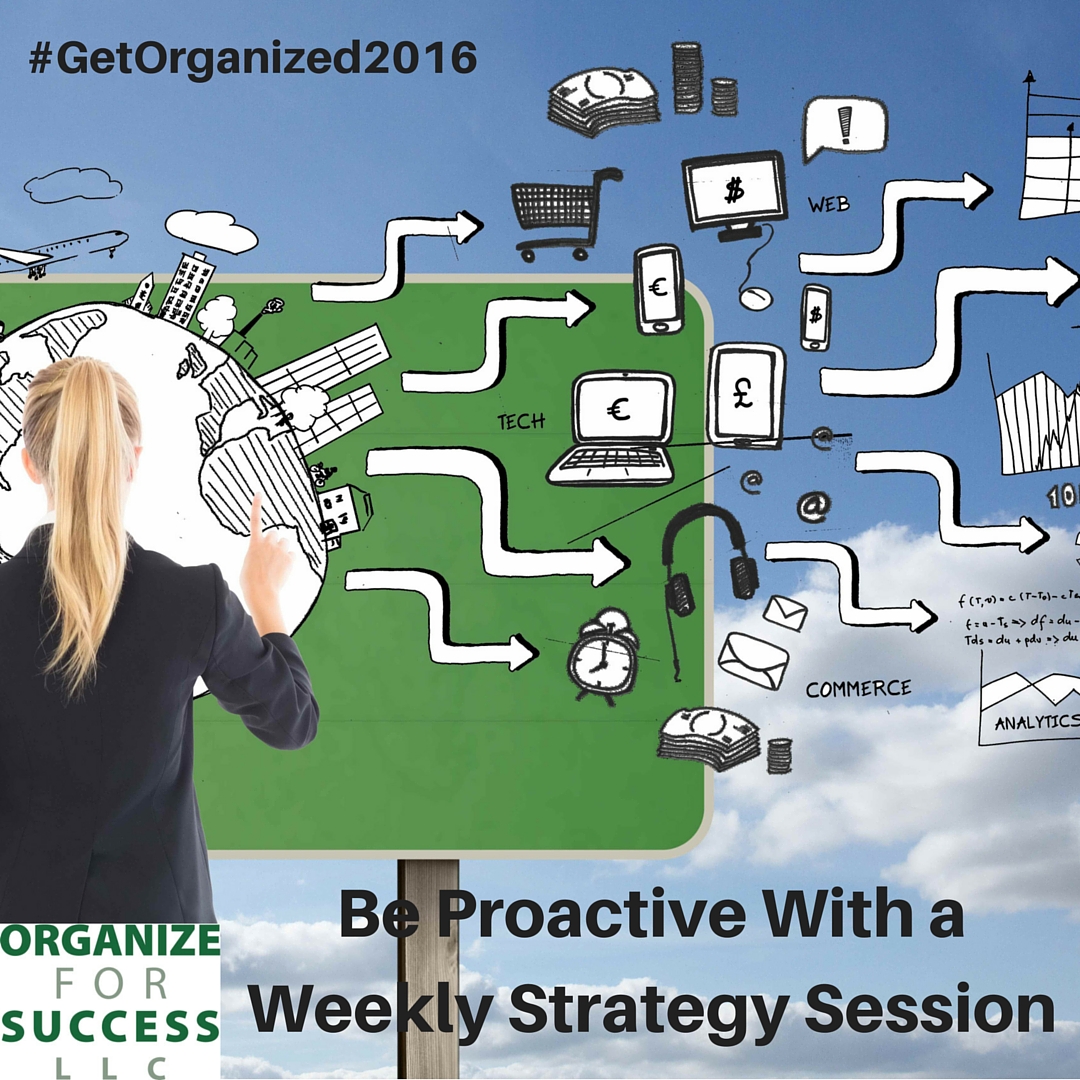
Be Proactive with a Weekly Strategy Session
If you have ever played or worked in athletics, you know there are many preparations that occur before each game, including scouting the opponent, preparing equipment and creating a game plan. Yes, during the game itself, there will be adjustments to the plan based off how the other team is playing, but coaches would never lead their teams into athletic competitions without creating a game plan prior to the start of that game. It is about proactively creating the direction in which you will proceed rather than starting in reactionary mode, not simply responding to the opponent's lead.
This same philosophy is certainly applicable to your own work-life integration. Take control of your productivity by creating your own weekly strategy, where you plan specifically for how you'll address the following:
- Tasks - Evaluate which tasks from the week ending were left undone and should be carried forward. When will those incomplete tasks get done?
- Team Communications - Get in-depth updates, including what's working, what's not working and what needs attention.
- Client Communications - Catch-up on emails and calls. Then, reach out to schedule time with those who have been needing your attention; connect with those from whom you've not heard lately.
- Time Commitments - Review the upcoming week's commitments to ensure you are prepared for related tasks, leaving buffers for travel as well as unforeseen things to pop up.
- Development - Determine opportunities for personal and professional growth; what will move you towards your goals?
As you complete your weekly review of the ending week and plan for the one ahead, be strategic and map out a specific game plan for addressing all that needs your attention. With only 1,440 minutes in each day, we must make every minute matter.
How are you strategic in addressing each week's needs? Do you complete a weekly strategy session currently? If not, will you schedule that now for this Friday or sometime over the weekend?
![]() |
| Make Every Minute Matter |
- Tasks - Evaluate which tasks from the week ending were left undone and should be carried forward. When will those incomplete tasks get done?
- Team Communications - Get in-depth updates, including what's working, what's not working and what needs attention.
- Client Communications - Catch-up on emails and calls. Then, reach out to schedule time with those who have been needing your attention; connect with those from whom you've not heard lately.
- Time Commitments - Review the upcoming week's commitments to ensure you are prepared for related tasks, leaving buffers for travel as well as unforeseen things to pop up.
- Development - Determine opportunities for personal and professional growth; what will move you towards your goals?
As you complete your weekly review of the ending week and plan for the one ahead, be strategic and map out a specific game plan for addressing all that needs your attention. With only 1,440 minutes in each day, we must make every minute matter.
How are you strategic in addressing each week's needs? Do you complete a weekly strategy session currently? If not, will you schedule that now for this Friday or sometime over the weekend?
Monday, January 4, 2016
Visualize Your Ideal 2016 to Make It Happen
One of the most successful methods for achieving a big goal is outcome visualization, where you create a detailed mental image of the desired outcome using all of your senses.
Today, take time to visualize your ideal 2016 so you can make it happen, paying attention to the details.
At the end of this year, how will you have spent your days? What will be your gross revenue? How many of what types of clients will have hired you? What did you start doing? What did you stop doing? What did you do more often than ever before?
Write your answers down; then, determine what needs to occur to make your vision a reality. What resources would help? What marketing efforts do you need to schedule? What types of networking do you need to incorporate in your upcoming plans? With whom do you need to interact more?
If you could use a little help getting started with outcome visualization, click here for Jack Canfield's step-by-step guide.
What is included in your vision for 2016? What needs to occur to make that vision a reality?
![]() |
| Succeed With Outcome Visualization |
At the end of this year, how will you have spent your days? What will be your gross revenue? How many of what types of clients will have hired you? What did you start doing? What did you stop doing? What did you do more often than ever before?
Write your answers down; then, determine what needs to occur to make your vision a reality. What resources would help? What marketing efforts do you need to schedule? What types of networking do you need to incorporate in your upcoming plans? With whom do you need to interact more?
If you could use a little help getting started with outcome visualization, click here for Jack Canfield's step-by-step guide.
What is included in your vision for 2016? What needs to occur to make that vision a reality?
Sunday, January 3, 2016
Be Filled With Gratitude
I am blessed to live a full life, filled with many people, places, things, experiences and opportunties for which I'm very grateful, including my wonderful clients, my fabulous friends, having a roof over my head and not worrying about from where my next meal will come.
Gratitude can be very powerful! Whether via a note-taking app or paper journal, take time to jot down that for which you're grateful each day. Some days, you may be in a rush and have time to add one item to your list; other days, you may be able to go into more depth. Regardless of how many you list each day, the process of recognizing all your blessings will drive awareness, fuel gratitude and boost productivity.
Will you keep an electronic or paper list? What can you list as that for which you are grateful today?
Saturday, January 2, 2016
Build a Solid Foundation for Your Greater Productivity
For many people, getting organized tops the list of new year's resolutions. All around us, there are people talking about what works for them and experts sharing tips to help. It can be very easy to say "I'll do that" or "That would be great for me" to all the ideas you hear; however, in my experience, trying too many things at once leads to failure and will discourage future efforts.
Instead, think about achieving your goals like eating an elephant. How would you eat an elephant? I have always heard the only way to eat an elephant is one bite at a time, which is the same way I look at attacking any project... Bit by bit by bit.
Once you've mastered one change, it is a much better time to move on to the next change than seeking to make multiple changes at the same time. Plus, each of those changes is rarely as challenging in reality as we envision it will be in our minds.
Which element of your productivity practices or workflow processes do you want to change first? Have you tried to improve previously and struggled due to attempting too many changes at once? I'd love to hear your experiences!
Instead, think about achieving your goals like eating an elephant. How would you eat an elephant? I have always heard the only way to eat an elephant is one bite at a time, which is the same way I look at attacking any project... Bit by bit by bit.
Attempt any productivity and organization tidbits one at a time, not all at once, and develop habits slowly so they really stick. Adopting new ways of doing things and making changes can be difficult, but it is much easier when undertaking smaller chunks instead of an overhaul all at once.
Once you've mastered one change, it is a much better time to move on to the next change than seeking to make multiple changes at the same time. Plus, each of those changes is rarely as challenging in reality as we envision it will be in our minds.
Which element of your productivity practices or workflow processes do you want to change first? Have you tried to improve previously and struggled due to attempting too many changes at once? I'd love to hear your experiences!
Labels:
change,
get organized,
get organized 2016,
goal,
happy new year,
make every minute matter,
new year,
new year's,
organize,
organizer,
productivity,
Raleigh,
resolution,
work-life integration
Saturday, January 24, 2015
Is It Time to Re-Start Your New Year's Resolutions?
Every January, we flip the page to a new calendar year, and many of us attempt to write a new story on the blank pages of a new year. We set goals and make resolutions, like "spend less, save more", "quit smoking", "get fit and stay healthy", "lose weight", "enjoy life to the fullest", "workout more", "work less" and "get organized". As National Get Organized Month, each January is the perfect time to GO and get started on these endeavors; however, if you get sidetracked or fall short of sticking with your resolutions, it's okay.
Have you had a bit of backsliding as related to your 2015 resolutions? Did you miss a scheduled workout as you are working to get in better shape? Did you forget to sort last week's stack of mail as you are working to get more organized? Don't fret! Instead, just start your efforts back up again.
If you were driving from Florida to Maine and got lost in North Carolina, would you simply turn around and return to Florida? Not likely. Instead, you'd probably just find your way and continue traveling to your destination. Achieving goals, meeting objectives and keeping resolutions can be exactly the same.
Be easy on yourself, don't feel guilty if you have setbacks, and, above all, do not give up. Your best bet for success is to break your goal into small, realistic steps and grow into your transformation. If you slide a bit, keep trying. I know you will eventually get there.
Friday, January 2, 2015
It's Not Too Late To Get Clear For The New Year
Each of us has only 1,440 minutes in each day, meaning 10,080 minutes in each week and just 525,600 minutes in each year to accomplish all we desire. Time is a limited resource so it is imperative that each of us manages our actions within the limited time we have to maximize it. Throughout the month of December, I shared with you a series of blog posts and related videos to assist you in making 2015 your best year thus far. The new year may have already kicked off; however, if you haven't already, you can still take action in organizing for your greatest success this year.
A. Verify your clarity in regards to priorities, goals and objectives.
- Click here for the strategic-planning questions that must be answered to derive your current priorities; then, create a goal for each of the determined priorities that is supported by a SMART objective, meaning Specific, Measurable, Assignable, Realistic and Time-related.
- Practice being strategic and proactive about which items you choose to give your limited time, utilizing the tactics shared here to say "no" when opportunities do not align with your priorities. Make time in your schedule for what brings you joy and matters most, realizing that every "yes" you offer means a "no" to something else; you'll want to be choosy with a "yes" reply.
B. Implement the following productivity tools to support your efforts in proactive scheduling:
- Weekly Strategy Session = Evaluate which of the prior week's tasks were left undone and determine when each can be rescheduled; review the upcoming week's commitments to ensure you're prepared for each task or appointment; determine growth opportunities, and map out a plan for proactively addressing your top priorities.
- Morning Jumpstart = Enter each day with 3 - 5 "must-do" items, and, then, start with the most difficult or vital task, maybe one that you've been avoiding which will bring great relief by accomplishing; take each element of any project step-by-step so it's manageable and feasible.
- End-of-Day Wrap-Up = Prepare the next day's "must-do" list, accounting for what didn't get done during the current day; verify you're prepared for everything on the next day's agenda; get end-of-day updates from your team, tidy up your workspace and reflect on your day's greatest success, making note of that for which you're grateful.
C. Capitalize on the Power of One with one of each productivity tool listed below:
- One calendar to include personal and professional, whether paper or electronic
- One place for all your to-do items, pulling daily must-do items from a running list of tasks
- One "data dump" so you search one place for everything that might need to be referenced
- One address book / contact relationship management tool
- One weekly strategy session as outlined above
D. Prepare your calendar solution for optimum success
- Make sure your calendar is equipped with all the holidays, birthdays, important events and reminders you'll need throughout the new year, adding alerts as needed.
- Get in a habit of documenting all activities; our brains are more for thinking than remembering.
E. Address any issues existing with your contacts solution
- Make sure all your contacts are in one place, whether personal or professional connections.
- Double-check that each contact record has the most up-to-date information, like phone number, email address, job title, place of employment and relevant notes; consider apps like EasilyDo, Humin, Sync.ME, Brewster, EverContact and FullContact to make that process easier.
- Develop a system for continually inputting updated or additional information.
- Click here to evaluate going from an address book to a Contact Relationship Manager.
F. Organize your morning routine to establish a proper foundation for a successful day ahead.
- End each night by planning for the next day's morning.
- Remove unnecessary actions from your morning routine.
- Streamline your processes for getting ready, including the addition of a "drop zone" by door.
- Make the most of every minute, giving consideration to how good health impacts productivity.
G. Clean out and organize your workspace so it is a powerful tool in your productivity toolbox.
- Take time to edit the contents, whether paper, electronic or objects, and retain only what's accurate, applicable, useful or bringing you joy.
- Address what emails you get daily, unsubscribing from what you no longer read and considering a bundle via Unroll.me for those you do read regularly.
- Verify everything to remain is strategically assigned a "home" and that you have a solution for what's to arrive.
What steps have you taken or will you take now to make 2015 your best year thus far? What is your vision for the new year, and how will you proactively prepare for success in it making that happen?
Monday, December 29, 2014
Get Clear For The New Year Week #5: Clean Out And Organize Your Workspace
Now that we are just a few days away from 2015, by following the assignments in this series, you’ve laid an excellent foundation for success in the new year; however, in order to achieve your optimum success, it is important to establish a work environment that’s yet another tool in your productivity toolbox. If your paper and electronic files are unorganized and filled with unnecessary contents, they can be overwhelming and unhelpful. This week is an ideal time to “get clear for the new year” by proactively addressing your filing as well as where items are kept in your workspace.
First, take time to edit the contents of your workspace. When files are overstuffed with outdated information, it is difficult to locate what you need when you need it; therefore, it is vital to address your files before the new year, clearing out what no longer needs to be there.
- Will the documents be relevant to work in the coming year? If you’ve completed the related project or the file contains last year’s receipts, move the content into storage with your archived files, rather than keeping it with your active files.
- Do you need this piece of paper? What’s the worst that can happen if you throw it away?
- Is the info on file somewhere else or easily accessible online?
If any file's contents are no longer (1) accurate, (2) applicable, (3) useful or (4) bringing you joy, consider getting rid of those contents. Can the discarded papers be recycled or do they need to be shredded? Further, if you are keeping something that would be easy to find again online, is it something you will reference frequently enough to justify the space it is taking to retain? Consider keeping only items that would be difficult to relocate or recreate.
Likewise, as you are purging the accumulated excess from your paper and electronic files, evaluate whether you can resell or recycle any technology that is no longer being used. Those devices, cords and accessories are taking up valuable real estate in your workspace, which could be devoted to items actually being used instead. Still, if you do utilize all the technological tools in your space, are there any that can be consolidated so you retain functionality while lowering the number of devices maintained? Keep in mind efficient use of what space you have.
Then, address the onslaught of emails received daily. Unsubscribe from eNewsletters you are not reading, consider bundling subscriptions that you do read via The Swizzle or Unroll.me and create a system for diligently keeping up on reading.
Take time to verify everything in your workspace has a home as well as that each item is in its assigned home. When folks are looking to buy real estate, you often hear “location, location, location”, and I challenge you to consider your workspace in the same light as buying real estate where location really does matter. The space closest to where you will be working is considered the most valuable real estate location; therefore, that area should be filled with what items you use most frequently. Then, the placement of items moving out from there should be based on how often the item is needed, placing items used least frequently the farthest away.
- Make certain there is a 2014 tax folder to hold incoming documentation for the year ending; then, create a 2015 tax folder to be prepared for the upcoming new year’s tax records.
- Get accounting records up to snuff by writing off uncollectable accounts receivable; while accounts receivable write-offs are tax deductions this year, they become a bonus if collected in the new year.
- Make sure your tech tools are housed near where they will be used, that all accessories are still easily accessible and that any upgrades needed are completed before the new year starts.
- Simplify your office supplies and plan space for what new supplies will be needed in the new year.
By focusing on editing out what is no longer needed and, then, strategically assigning homes to what you will be keeping, your workspace will be a useful tool in your productivity toolbox, driving your optimum success.
ASSIGNMENT: Visit here to see a video related to this blog post; then, this week, take time to edit the contents of your workspace, removing contents that are no longer accurate, applicable, useful or bringing you joy, and verify everything to remain has a home as well as that each item is in its assigned home. What needs to be added or removed in order to simplify your work for better achieving your desired results? Be strategic, aligning the set-up in your workspace with the goals you’ve set, making sure the workspace is another tool in your productivity toolbox.
Leave a comment below about your ongoing system for editing the contents of your workspace. What tends to build up most quickly? How will you maintain the productive workspace that you’ll be creating this week?
Monday, December 22, 2014
Get Clear For The New Year Week #4: Organize Your Morning Routine and "Drop Zone"
As we talk about steps you can take now to make the new year your best thus far, empowering you with the optimal tools to drive your desired workflow results, it is important to address how your days start and end. Whether you are a morning person or night owl, your productivity depends on a proper foundation, which comes from your morning and evening routines. Take these steps to minimize the madness so you are ready on time and your exit each day is much less stressful:
- End today with tomorrow in mind… Each night, check the next day’s schedule to plan what you’ll need for all activities. Verify the weather forecast and lay out your clothes for the day as well as any accessories you’ll be wearing. Think through what you will eat for breakfast so you aren’t scrambling for something to eat. Go ahead and prepare the next day’s lunch; likewise, if you often forget to grab your pre-made lunch from the fridge, leave yourself a “remember lunch” note on the door or by your keys. Have a set place near the door for any items you’ll need to grab as you’re headed out the door, like your keys, work files and purse / wallet / backpack; plus, keep a morning checklist by the door to verify you have all that you need. Make sure you have gas in your vehicle. Finally, finish your evening with a tablespoon of unsweetened almond butter, which will ensure you don’t awake groggy from low blood sugar.
- Remove unnecessary actions from your morning routine… When the goal is getting out the door, it is important to stay focused, but it is easy to get distracted. Can unloading the dishwasher wait until after work? Can you absorb the morning’s news on your commute to the office instead of in the morning news on TV? For some, these actions are necessary to start the day off on the right foot; however, for others, they are simply distractions that lead to tardiness in getting out the door. Determine in with of those groups you fall and act accordingly.
- Streamline your processes for getting ready each day… Choose a hairstyle that is easy to maintain. Choose a breakfast that is easy to prepare and can be replicated each morning. Choose wrinkle-free clothing. Look at each element of your morning routine, and determine what can be simplified. Doing more without thinking makes the whole process better.
- Make the most of every available minute… Set your alarm clock to go off 15 minutes earlier than necessary to give yourself a buffer in your morning preparations. Get up and moving soon after you awake to open your lungs for more oxygen, which helps our brains and bodies function properly; I use the 7 Minute Workout app, and you might want to give it a try, too. Start your day by drinking a tall, cold glass of water with a squeeze of fresh lemon juice, which boosts energy, promotes good digestion, encourages your immune system’s functioning, detoxifies the liver, helps you lose weight, encourages better skin and kicks off your day hydrated. Break each element of your morning routine into a “zone” so supplies for each action are grouped together and located in the area where they will be needed, like tools for getting dressed, tools for prepping your face or applying your make-up, tools for preparing your coffee and tools for making your breakfast. Further, use music to motivate your desired behaviors.
With a little planning, preparation and routine-building, it can be easier and less stressful to get out of your home. quickly moving on to your day’s activities. Still, one of the most powerful tools for organizing your morning routine might be the aforementioned place near the door set aside for any items you’ll need to grab as you’re headed back out the door. This is known as your “drop zone” and is where you drop off those items when you arrive home so you can quickly locate them when you are ready to leave. Normally, this includes your keys, work files and purse, wallet or backpack; however, anything you bring home that will be needed when you leave should be left in this “drop zone” so you aren’t frantically searching in the morning.
ASSIGNMENT: Visit http://youtu.be/NzQAsfEk9Vc?list=UUEoZpJ_B6A1dWLzzsSVTwbg to see a video related to this blog post; then, this week, review your evening routine to make sure you are properly preparing for the next day, establish your “drop zone”, starting to develop a habit for using it, remove unnecessary actions from your morning routine, streamline your processes for getting ready each day and see how you can make even more out of every available minute in your morning routine. Do you need to awake earlier? Are you moving around soon after awaking? Could you add the cold glass of water with a squeeze of fresh lemon juice to your morning routine? Are you utilizing music?!?
Leave a comment below with what’s working best for you. What is your nightly routine? What is your morning routine? How have you simplified either to make it more helpful?
Monday, December 15, 2014
Get Clear For The New Year Week #3: Organize Your Calendar and Contact Systems
As we talk about steps you can take now to make the new year your best thus far, we are empowering you with the optimal tools to drive your desired workflow results, which must include your calendar and contacts’ list. While many might contend that “one is a lonely number”, when it comes to your productivity, I say that one is a very powerful number. With that in mind, I highly recommend you address your productivity toolbox like you are one human-being, not a personal you versus a professional you, which means...
One Calendar: A single planner enables tracking all commitments in one place, making it less likely to forget anything. Having business and personal showing at once will allow scheduling for you as one full entity and better ensure that nothing falls through the cracks while you avoid any double-booking.
One Place for All Your To-Do Items: Keeping all action items that need your attention in one running list allows you to easily pull 3 - 5 items for each day’s must-do list, making it more likely all will get done, aiding in prioritizing and empowering you to assign each “what” a “when” so time is scheduled for its completion.
One “Data Dump”: Our brains are designed to think, not remember, but we fill them with more and more each day; keeping all that we’d like to remember in one place (such as in your Evernote database) ensures meeting notes, ideas, phone messages, inspirations and the like are easily accessible from anywhere.
One Address Book / Contact Relationship Management (CRM) Tool: For contacts’ names, phone numbers, emails and snail mail addresses as well as any related notes, keeping everyone’s information centralized better ensures contacts’ data is kept up-to-date and accessible. When updates must be made in numerous places, they’re less likely to get done.
One “Weekly Strategy Session”: As we discussed last week, dedicating time each week to creating a game plan for the upcoming week means more gets done and keeps you on the right track, especially pared with a morning jumpstart and end-of-day wrap-up. With this trio of tools, you stay in control of your actions.
____________________________________________________
To elaborate on steps you can take right now to prepare for your greatest successes in the new year, here are a few calendar-related items to consider and incorporate in your actions:
- Whether paper or electronic, make sure your one calendar solution for 2015 is equipped with the holidays, birthdays, important events and reminders that are most important for you. If any are missing, add them now; plus, if your solution is electronic, add alerts as appropriate to keep you on track.
- Get in the habit of documenting all activities; rather than depending on your brain or a running list of events, let your calendar do the heavy-lifting for all date-specific commitments.
- As you become more comfortable with your weekly strategy session, morning jumpstart and end-of-day wrap-up, you’ll view your calendar solution as a bigger and bigger part of your productivity toolbox; with all the options available, there is guaranteed to be a good fit for your specific needs. Test out what options exist until you find a good fit for your needs, whether paper or electronic, daily or weekly or monthly view.
____________________________________________________
Likewise, to further elaborate on steps you can take right now to prepare for your greatest successes in the new year, here are a few contacts-related items to consider and incorporate in your actions:
- Whether paper or electronic, make sure your one address book or CRM tool is filled with all your contacts, whether personal or professional, including clients, team members, vendor partners, friends, family members, neighbors, industry contacts, networking connections or referrals.
- Double-check that each person’s record includes the most up-to-date information for contacting that particular individual, including that person’s current phone number, email address, job title, place of employment and pertinent notes. If you are looking for a technological tool to shortcut this process, consider apps like EasilyDo, Humin, Sync.ME, Brewster, EverContact and FullContact.
- Determine what will be your system for continually inputting updated or additional information as it is brought to your attention. While this may be resolved via one of the aforementioned apps, if someone mentions her new job to you when you’re meeting face-to-face, you’ll need a specific process to document the associated updates and, then, add them to your contacts’ solution. You might want to document them in your “data dump” and schedule one block of time weekly to transfer the updates.
- If you would like a solution that does more than any address book can complete, consider a Contact Relationship Management (or CRM) Tool. With a CRM tool, you remember everything about each individual with whom you’ve connected and you make sure no opportunities fall through the cracks. As you are searching for your best option for a CRM solution, determine whether its ease of use, accessibility, customization and integration with other tools all meet your specific needs; then, make sure you test drive the product before making any short- or long-term commitment. Options that deserve some consideration are ACT!, Infusionsoft, Insightly, Nimble, OntraPort and Zoho CRM.
Speaking of CRMs, as these provide structure for walking prospects through a sales process, they empower leaders to hold team members accountable, measuring each team member’s success rate as they move prospects from step to step of the sales process. Be sure that each team member is aware of what consequences exist for not utilizing the designated sales process, provide resources for improving conversion rates and hold each team member accountable for trying to improve. Via structure, customer relationship management boosts success.
____________________________________________________
ASSIGNMENT: Visit here to see a video related to this blog post; then, this week, clarify what you’ll use as your one calendar solution, one place for all your to-do items, one “data dump”, one contact management solution and one weekly strategy session. Then, make sure your calendar solution includes alerts for any applicable holidays, birthdays and important events, starting to develop the habit of documenting all activities in this one calendar solution. Finally, verify you have the most up-to-date contact information for everyone in your database and choose a tool and / or process for ongoing maintenance of contacts’ data.
Where has “the power of one” proven most helpful for your productivity? Do you prefer a paper or an electronic solution for your calendaring tool? Alternatively, do you utilize any apps to help maintain your contacts’ information? Further, are you using a paper or electronic address book or do you prefer a CRM tool instead? What do you find as strengths and weaknesses of paper versus electronic for any of your current productivity tools?
Labels:
address,
boost productivity,
calendar,
contacts,
CRM,
customer relationship management,
efficient,
Evernote,
new year,
organize,
productivity,
Raleigh,
strategic planning,
strategy,
task management,
tasks
Monday, December 8, 2014
Get Clear For The New Year Week #2: Weekly Strategy Session, Morning Jumpstart and End-of-Day Wrap-up
Last week, we discussed determining and, then, focusing your actions on your personal and professional priorities, goals and objectives. To do this successfully, it is imperative to be proactive.
If you wait until your week unfolds, you are often at the whim of others’ priorities; if you take time to plan your approach beforehand, checking your progress throughout, you are more likely to build a structure for focusing on what’s most important to you. Here are tools I recommend building into your regular habits for ensuring the greatest success in marrying your actions to your priorities:
I. Weekly Strategy Session: Whether you accomplish this at the end of your Friday, sometime over the weekend or first-thing on Monday morning, it is imperative to create a game plan for the upcoming week. Just like football teams wouldn’t go into a game with out a plan, you need a game for accomplishing all you intend for your week. In each weekly strategy session, focus on these items…
- Evaluate which of the prior week’s tasks were completed, determining what’s left undone and must be carried into the new week; then, reschedule each undone “what” to a new “when” so you have a clear timeline for winning.
- Clarify any changes to your priorities so those people and activities most important to you get scheduled accordingly; start your weekly game plan by allocating time for what’s most important before anything else.
- Review the upcoming week’s commitments to ensure you’ve prepared for the related tasks and appointments; as appropriate, include when you’ll sleep, when you’ll workout and what you’ll eat.
- Determine additional opportunities for personal and professional growth; what actions or connections will move you towards accomplishing more of your goals?
- Map out a game plan for the upcoming week’s activities, remembering that every “what” assigned a specific “when” is more likely to get done but that you have only so many minutes allocated to your week.
II. Morning Jumpstart: While we all believe we are superheroes who can accomplish a never-ending list of tasks and appointments, each of us is only one human-being; therefore, it is important to start the day on the right foot to accomplish all that is realistically possible. Jumpstart your morning in these ways...
- Enter each day of your life with 3 - 5 items that are “must do” for that day, whether those are appointments or tasks, as that is a realistic goal. If you complete more, that is a bonus.
- Follow the philosophy of “swallow the frog” such that you complete the most difficult and vital task or item you’ve been avoiding before moving to others.
- Keep in mind the saying that an elephant is eaten one bite at a time, and break projects into smaller, more manageable action items, starting each of these on your list with a specific verb.
III. End-of-Day Wrap-Up: I like to think of the last 15 minutes or so of each workday as my “check-up from the neck up”, and I always aim to accomplish the following activities…
- Review the day’s tasks, preparing the next day’s “must do” list based off what was left undone from today as well as what must be done for tomorrow.
- Evaluate your schedule for the next day and verify that you are prepared for everything coming up.
- Get end-of-day updates from each of your team members.
- Tidy up your workspace, filing newly arrived items while putting the day’s work back into each item’s assigned home.
- Reflect on your greatest success from that day, and make note of that for which you are grateful.
If you’re having trouble completing any one of these processes or think they are taking too long, you can use a timer to move things along… Here are a few benefits from using this productivity tool:
- Once you get rolling, you might not stop as activity breeds activity, ending procrastination.
- You can do anything for 15 minutes or so, better keeping yourself focused over a shorter duration.
- Shorter times allowed for specific activities lead to an extra burst of energy, driving greater output.
ASSIGNMENT: Visit http://youtu.be/Kt0UAyzyvpQ to see a video related to this blog post; then, this week, start developing the habits of a weekly strategy session, morning jumpstart and end-of-day wrap-up. Find an existing habit with which you can connect each of these new processes so you are more likely to get them all completed; then, set a timer to see how quickly you can accomplish each one. Reward yourself for successfully doing each of the three, celebrating every step towards developing them into habits.
Do you currently complete a weekly strategy session, morning jumpstart and / or end-of-day wrap-up? If you do, how have these boosted your productivity? If you don’t do them already, how can you incorporate these into your existing workflows to better boost your output?
Saturday, December 6, 2014
6 Ways to Stay on Track Amidst the Holiday Hustle
As of today, we are just 10 days from the start of Hanukkah, 19 days from Christmas and 26 days from New Year’s Day, which can mean exceedingly long to-do lists over and above the normal, day-to-day workload: decorating, cooking and baking, shopping, wrapping, sending cards, television specials, parties, traveling, out-of-town visitors and much, much more… Whew! It can be extremely overwhelming, but there are steps you can take to help:
1. Be proactive and strategic about handling all your job requires. While team huddles can be good for some, all individuals can benefit from a weekly strategy session done alone for appropriately scheduling time for necessary tasks, meetings, professional growth and current priorities. By assigning a specific “when” for every “what”, more gets done and you have more wins. Then, keep that weekly game plan on track with a daily wrap-in in the last 15 minutes of each workday, where you complete a “check-up from the neck up” for tasks and appointments, get updates from each of your team members, tidy up your workspace, acknowledge the day's successes and show gratitude.
2. Take a look at your ongoing tasks and activities; see what can be deferred until after the holidays. During this time of year, we add so many activities to our already full calendars, but there are only so many hours in any day… Each time we say "yes" to something, we are saying "no" to something else; when each opportunity arises, make a conscious effort to consider, "If I say yes to this, to what am I saying no?" What can be set aside to make room for your priorities this season?
3. Make time for self-healing and keep self care a priority. Whether it is a massage, a coffee break with friends, reading the latest and greatest novel, a quick nap, time to reflect in nature, exercise or just a bit of silence in front of the fireplace, it is vital to fuel yourself in order to have any energy for giving to others.
4. Take vacation time off to handle holiday obligations. While you can’t add hours to the day, you can manage your actions for optimizing the time you have by taking some time off to finish shopping, cooking or decorating. This approach empowers you to be fully focused when you are at work, knowing you have adequate time set aside for those holiday commitments. Likewise, if you are the team lead, be aware of everyone’s desires for vacation time, and be careful to balance employee vacation requests with business needs; consider having a policy for no vacations on especially busy days or limiting the number of days off during the holidays, focusing on giving folks the time off they need to be fully engaged while at work at the same time as getting all work done.
5. Know when to ask for help. While successful collaboration, communication and scheduling can enhance your team’s ability to diffuse the company’s workload, utilizing all available bandwidth, don’t forget that there are plenty of options for outsourcing and delegating outside your organization. There are many resources, including Elance, Fiverr, Sweeps, Task Rabbit and Thumbtack, that are excellent solutions for helping with holiday overload. Utilize all available resources to optimize results.
6. Make lists for all that must be done, bought, wrapped, decorated, cleaned, etc. When faced with holiday-season projects, break each into bite-sized, action steps that can be more easily tackled; checking individual steps off will keep you motivated to continue. Then, whether paper or electronic, be sure to keep your list with you throughout the season, referencing it often.
What tactics do you utilize for maintaining productivity during the holidays? How do you incorporate seasonal commitments amidst your day-to-day routines? Have you noticed any hiccups thus far this year?
Monday, December 1, 2014
Get Clear For The New Year Week #1: Priorities, Goals, Objectives and Saying No To What Doesn't Fit
Today, successful small businesses must make changes quickly when needed. Technology is evolving rapidly, dramatically altering the way in which businesses find, interact with and meet the needs of clients. The number of employees continues to be cut while resources become more limited, continually asking small businesses to do more with less. We're often reminded how important collaboration, communication and scheduling are when looking at our own successes as well as our teams' successes.
Chances are good that your expectations for the new year are even higher than what you had in mind and have accomplished in the year that’s ending. If so, take action now to make changes for improving your business moving forward. In my “Get Clear For The New Year” series, I’ll post each week of this month about steps you can take now to make the new year your best thus far, empowering you with the optimal tools to drive your desired workflow results.
Let's start by discussing the foundation for your upcoming success: your priorities, goals and objectives. Each of us has 1,440 minutes in each day or 10,080 minutes in each week, which means we have only 525,600 minutes in all of 2015 to achieve everything we desire. Time is a limited resource, and we cannot add to that allocation. Instead, we can only manage our actions within that allocated time to do all we possibly can. With such a limited allocation of time, it is extremely important to be focused on how we want to use it.
As Stephen Covey encourages, think of each week in your year as if it were a jar. In front of you, you’ve been given a pile of rocks, a pile of pebbles and a pile of sand. Those rocks represent actions to support the most important commitments in your life, whether your career, your health, your loved ones, your education, volunteering for a cause that’s important to you or something of equal priority to you; there are serious consequences if these tasks are left undone. The sand represents actions that are neither important nor urgent but can be good releases throughout your day, week or month, like watching funny videos on YouTube, playing video games and catching up on personal social media. Then, the pebbles represent what actions fall in between the importance levels of your rocks and sand; often, what are currently considered pebbles would become rocks if they are postponed for too long, but you currently have a little wiggle room on them. The pebbles represent tasks with slight but manageable consequences if left undone. Each week in your year can hold only so many of your rocks, pebbles and sand; be strategic and proactive about which items you choose to give your limited time. As indicated in the video at http://youtu.be/6_N_uvq41Pg, if we each allocate time for what’s most important first, we’re more likely to have more time to accomplish much more of the rock, pebble and sand items that we desire.
In these last few weeks of 2014, it’s important to clarify your rocks, pebbles and sand, creating the habit of scheduling each week with time allocated for rocks before pebbles before sand. To determine your business’ rocks, it is imperative to be clear about what are your company’s priorities and goals. Jumpstart this analysis and move towards clarity on your priorities with these strategic-planning questions:
1. What is the one thing your organization did best this year, and what is needed to repeat that success?
2. What is the one thing your organization most needs to improve, and what must happen to fix it?
3. Which groups or individuals have prevented your organization from reaching its greatest possible success, and what can be done to remove that hurdle?
4. Which groups or individuals were most responsible for your organization’s successes this year, and how can those folks be shown appreciation while encouraging that success to be repeated in the new year?
5. What performance metric has been falling below expectations, and what can be done to correct that?
6. What performance metric most closely reflects whether your organization is operating successfully?
7. Which products or services offered by your organization are most profitable? Least profitable? How can business operations be more aware of the profitability aspect for what products and services are offered?
8. What resources can help team members better achieve the organization’s goals, like networking, administrative support, technological tools or more streamlined processes?
9. About what results are you most passionate, excited and motivated? How can you focus more intently on that specific facet of your organization?
10. What areas of your business can be outsourced or automated to achieve better results in other areas?
From your answers to these questions, you can deduce which areas of your business rank as your highest priorities headed into the new year. Create a goal for each of the determined priorities; then, make sure that each goal is supported by SMART objectives, meaning they are Specific (targeting an exact area that is to be improved), Measurable (able to quantify progress), Assignable (have specified who will complete), Realistic (associated with results that can realistically be achieved with available resources) and Time-related (to be achieved by a specified deadline).
Heading into a new year means a blank slate, and focusing your actions on your personal and professional priorities can lead to outstanding outcomes; however, it can also mean changes to your existing behaviors or habits, which is challenging. As opportunities come your way that are not aligned with your priorities, it will be important that you are armed with ways to say “no”… Here are a few examples:
- Let go of the kind of work you do not want to be spending your time on by saying “Unfortunately, I simply don’t have time for that right now”, which opens space for doing the work that really deserves your time.
- If someone approaches you with an idea, venture or suggestion in which you are interested but you just don’t have the bandwidth to consider it at this particularly busy time, say that this is a busy time for you, and ask that they contact you again after whatever date you specify as being a less busy time; this approach avoids your overwhelm by putting the ask back on the asker’s to-do list.
- Although you never owe the other person more explanation than you feel comfortable giving, if you choose to elaborate a bit more, you can always say “I’d love to, but I’ve got other commitments right now”, and feel free to explain to whatever degree you prefer what those other commitments might be.
- You can always choose the more direct approach, saying “It’s a no, I’m afraid, but thanks for asking me."
- Whenever you are overwhelmed by your current commitments and turning down a new alternative, I find it very successful to be upfront and clear about your state of overwhelm; examples of this approach include “I’ve got too much on my plate right now” or “Bandwidth is low so I won’t be able to make it work."
Whenever you are offering a “no" response, it should always be truthful, firm and not overly apologetic or explanatory; once you’ve made the decision to say “no”, try to not overthink it and always take action.
ASSIGNMENT: Visit http://youtu.be/tls8uNfeBao to see a video related to this blog post; then, this week, take time to answer the aforementioned strategic-planning questions, deducing what your priorities might be. Practice scheduling your week to focus more intently on your priorities, and brainstorm goals as well as SMART objectives associated with those priorities. Make time in your schedule for what matters most.
What are your priorities, goals and objectives? How do you make time for what’s most important? How do you move away from opportunities that do not fit your priorities?
Monday, January 20, 2014
Is It Time To Re-Start Your New Year's Resolutions?
This year was going to be different, right? Yet, now that we
are a few weeks into the new year, are you struggling with your new year’s
goals? Might you be backsliding a bit? Have no fear… You can restart at any time! Take a
moment to check out my “Apps,
Websites and Tech Tools To Move You Towards Your Goals” post at http://wp.me/p3M0SC-2h8 for tech tools that can help you
veer back onto the right path for your resolutions. Meanwhile, there are additional steps you can start this
week to be more efficient, waste less time and open space in your life for
achieving the goals and resolutions you set for this new year. Here are a few
ideas:
- Streamline your calendar system with (a) one place for all your time commitments, (b) all activities documented and (c) starting the habit of regularly reviewing that planner to start as well as end each day.
- Schedule your weekly strategy session as a repeating event on your calendar, giving you the opportunity to outline your game plan for attacking each week’s to-do items, appointments and opportunities for personal / professional growth.
- Organize your paper and electronic filing solutions with (a) a purge of outdated contents or overstuffed files and (b) a verification that everything in your workspace has a home as well as that each item is in its assigned location.
- Systematize your “drop zone” upon entry and exit of your home and office so you aren’t scrambling to find your car keys as you’re running out the door.
- Consolidate your contact system into (a) one address book, (b) updated information included for each person’s record and (c) starting to build a foundation for your system of continually inputting updated / additional contact information as it is brought to you by your contacts.
- Make certain you have a tax folder easily accessible to hold incoming documentation for the year that recently ended; then, create another file for tax-related items coming in for this new year, too.
While all of these action items in one list might seem a bit
overwhelming, think of how you can break them into bite-sized portions to do
each one throughout the remainder of the month. Alternatively, is there someone
to whom you can delegate any of these items? Or is it time to pick which one is
most relevant to your needs and bring me back in for a “check-up from the neck
up” on that particular area of focus? No matter which path to productivity you
choose, take time to act now because you can make a
difference.
What did YOU resolve
for 2014? Have you had success? If not, which of these techniques can you implement
this week to open up time for moving you towards your goals? I look forward to our dialogue with your comments below.
Subscribe to:
Posts (Atom)