Brought To You By Emily Parks
Productivity Consultant at Organize For Success, LLC...
Helping You Make Every Minute Matter!


Showing posts with label teamwork. Show all posts

Monday, April 23, 2018

Does America Have an Unhealthy Focus on Labels?

Photo by Pro Church Media on Unsplash
Recently, I was an attendee at a non-profit gala; when I was unable to hear the speaker due to attendees talking and poor audio technology, I tapped my knife against my glass to get folks refocused on the speaker, hoping to not miss anything important being said. Unfortunately, by trying to wrangle in the crowd such that I could benefit from a little less background noise, I got labeled as a control freak, which surprised me. The person who said it was simply joking, but the experience did get me thinking.

According to a quick google search, control freak is defined as "a person who feels an obsessive need to exercise control over themselves and others and to take command of any situation." Likewise, the Learning Mind explains "10 Signs You Are Dealing with a Control Freak" as (1) They always correct people when they are wrong, (2) They always criticize and judge other people, (3) They are leaders, not team players, (4) They take full credit for their successes, (5) They will never admit when they're wrong, (6) They know what's best and try to change others to fulfill own agenda, (7) They spend a lot of their time trying to prevent bad things from occurring, (8) They never delegate tasks to others, (9) They always have to have the last word, and (10) They have no time for anyone who makes a mistake. I will happily admit that I do spend a good deal of time trying to prevent bad things from occurring, hence why I own a productivity consultancy, and I dislike wasting time with folks who consistently make the same time-wasting mistakes over and over again; however, there is a big difference between committing each day to making the world a better place and being a control freak.

Lately, in the media, there has appeared to be a movement toward "You do you", including an awesome book entitled You Do You that was published in November 2017 by Sarah Knight. Yet, as a business owner and community leader, I find it's important to be cognizant of others' perceptions of you because they directly lead to how those making assumptions about you will respond to your needs, initiatives or offerings. The tricky part is that no one can get inside another person's head, and human nature is to fill in the blanks of what's not been shared verbally or visually; usually, how we fill in others' blanks is not how those folks would fill in the blanks for themselves, but we can base our fill-in-the-blank answers on only our personal experiences, perspectives and thoughts. Similar to deeming someone to be a control freak would be the label of perfectionist or saying that someone lacks time management skills. They are assumptions, and we've all heard the saying about what assuming makes us.

Since humans can't get inside each others' heads, how do we know that our definition of perfect does or doesn't match someone else's definition of perfect, how can we determine if someone's longer hours working on a project are because they are trying to get it "just right" and aiming for perfection or simply trying to figure out how to get it done at all, how can we decide that someone is late because they have poor time management skills versus simply having had a more pressing priority pop up to deviate a timely arrival and who are any of us to determine another person's delegation skills if we don't know for certain who is actually getting everything done that we are attributing to that person?

Teams are made stronger, more productive and far better at achieving greater results by bringing together diverse individuals with varying experiences, perspectives and thoughts; however, the power behind including diversity within any group is limited by the communication skills of all team members. Are we subconsciously sabotaging our teams? How do we speak up so others don't make inaccurate assumptions about us? Or how do we ask questions to get others' true answers instead of filling in the blanks incorrectly?

When presenting a team-building workshop to a client earlier this month, we focused a good deal on embracing varying perceptions as we cling to the wisdom from Michael Jackson's "Man in the Mirror" song lyrics that we can change only ourselves, not others. In other words, we have to be "starting with the man in the mirror", and I find the Serenity Prayer helpful in knowing how to react to any given scenario... "God, grant me the serenity to accept the things I cannot change, the courage to change the things I can, and the wisdom to know the difference."

Are the assessments we make of others helpful as we attempt to focus on what we can change about ourselves? Moreover, as humans, how can we reign ourselves back and stop making such assumptions of others? How does the human impulse to apply labels impact our success in teams?

Saturday, January 27, 2018

Communicate to Collaborate for Greater Results

A quick Google search reveals that collaboration is defined as "the action of working with someone to produce or create something"; I contend collaboration is partnering with others to create something greater than can be produced alone. It is the very principle on which the team acronym of "Together, everyone achieves more" was created.

If we define team as "a number of persons associated in some joint action", we illuminate the importance of each team being results-oriented, focusing on achieving the desired outcome from that joint action and bringing complementary skills together in working towards a common vision. The trust, accountability and interdependence of a team depends heavily upon how well the individual members can communicate, meaning each must "impart or interchange knowledge, thoughts, feelings, opinions, information and ideas by speech, writing, gestures or signs" in order for all team members' differing contributions to combine for producing greater results related to achieving their unified mission.

Whether your team is everyone in the same department at work, a volunteer committee for a non-profit organization or the members of your family, there is always a need for optimal communication, and we must put effort into continually improving this skill.

Here are best practices for your team to improve communication:

  • Use the right tools at the right times. Research found that only 7% of any message is conveyed through words, 38% through vocal intonation and 55% through non-verbal elements, such as facial expressions, gestures and posture. Therefore, carefully consider the pros and cons of each communication channel before choosing which is the best for sharing what message needs to be conveyed: text, chat, email, phone call, video conference or in-person meeting.
  • Speak in the language your audience will best hear. I don't mean choosing between English, Spanish, Japanese, Russian, Italian or Portuguese. Instead, I mean choosing words that appeal to the way your audience prefers to take in information, process it and make decisions based on acquired information. Some people prefer to take in information by using their five senses while others go beyond what is real or concrete and focus on meaning, associations and relationships to take in information that they trust. Some people seek to experience the world, not organize it, while others look at the world with an eye for what decisions need to be made, utilizing a planned approach to meet the deadlines set for decisions to be made in a scheduled way. Some people make decisions based on impersonal, objective logic while others use their personal values to understand the situation, focusing on relationships and harmony. Some people make decisions based off reasoning while others focus decision-making on emotions, responding to their gut more than their brains. When you customize your message for the person to whom you'll be saying it, you better ensure the message is received.
  • Avoid overload. The age of the Internet gives us instant access to knowledge and correspondence, making us constantly susceptible to an information avalanche. It's easy for any individual message to get lost amidst the clutter, no matter how important it is. Effective communication shares the right information with the right audience at the right time. Since less is more, keep your message simple, brief and to the point, sharing updates only when appropriate. 
  • Help everyone stay away from making assumptions. Whenever there is missing information or we haven't been updated on the status of something, as human-beings, we automatically fill in the blanks. Unfortunately, we often fill those blanks with inaccurate or incomplete information. Focus on eliminating blanks in what you communicate to others, filling them in with what you want others to put in those blanks instead of what they'd assume from their own perceptions.

Are there certain folks with whom you struggle to communicate well? Which tactics from this list could you incorporate in communications with those people for greater effectiveness and to better achieve your desired results?

Monday, March 7, 2016

Is Your Team Filled With March Mania?

Whether you are not a fan of basketball at all or you are wildly cheering for your favorite team, you're probably well aware of the fact that March mania is here, which means college basketball is heating up and folks are getting their office pools started. As conference champions are crowned and the madness of the National Collegiate Athletic Association basketball tourney nears, I see many parallels.

If you're asking what successful businesses have in common with winning basketball programs, here are a few of their similarities:

- Teams need strong leadership. For sports programs, that leader is the head coach, and Coach Mike Krzyzewski is a shining example of how strong leadership creates a winning environment. The leadership lessons from Coach K are limitless, like "Make people feel you, not just understand you", "Be responsive to the short-term goals, but never lose sight of your long-term mission", "Empower others to scale and sustain your impact", "Meet your people where they are" and "Your platform is a gift... Use it wisely"; however, there is no question that leadership is needed to succeed, and that same principle applies to any company's team.

- Team is defined as "Together, Everyone Achieves More". Each individual is human, which means our abilities are limited; however, if everyone is contributing to the same goal, the sum of those parts creates a much larger impact than any one can do individually. Larger goals can be achieved when everyone on the team is working together, associated in a joint action. For a college basketball program, that would be an NCAA Tournament championship; however, for your company, that success comes in achieving whatever "big, hairy, audacious" goal your team set for itself. Loftier goals are achieved only when working together, like the members of a crew rowing in sync and in the same direction.

- Teams succeed when members skillfully fulfill their roles. Throughout the history of basketball, the most successful teams pass the ball more on each possession than their opponents, trust their teammates to be in the right position at the right time, communicate clearly as to what is needed of each role player and have team members that dedicate themselves 100% to the specific roles asked of them. Whether asked to play point guard, shooting guard, small forward, power forward or center, each member of the team knows their role and how it meshes with the other roles to achieve the team's greatest goals. Winning teams pull together groups of stellar athletes to win against schools that have "the best player" but no one on the same page to fill the other roles.

Whether a basketball team or business entity, when each member does an assigned part and carries the associated workload, the combination of those roles is a winning team, where the synergy from working together creates bigger, better, stronger results.

Do you have a favorite sports team? How does that team exhibit principles of teamwork to make it more successful? How can your company implement the teamwork tactics of your favorite sports team to achieve greater success?

Monday, March 9, 2015

Tips to Utilize Email for Adding & Organizing in Evernote

Last week, I shared with you the many forms of information that can be added in multiple ways to your Evernote database. In that list, I included "send to your Evernote account's email address", but that might've led to even more questions. Let's dive a little deeper into this functionality.

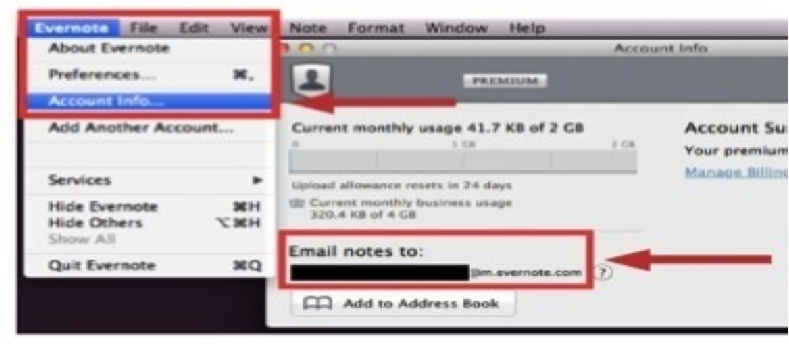
On a laptop or desktop version of the Evernote app, follow Evernote > Account Info > Email Notes To for finding the email address assigned to your specific database. Likewise, on the iPad or iPhone app, tap the elephant head image to get back to your main menu; from there, tap the gear image in the top, left-hand corner, follow General > Evernote Email Address, and you will see the email address assigned to your specific database. Finally, on an Android version of the Evernote app, tap the image of three dots stacked vertically to follow General > Evernote Email Address, and you'll find the email address assigned to your specific database.

Whatever you see as that email address assigned to your Evernote database is designed to be complicated and difficult to remember so others can't start sending content into your Evernote account. I find it's not realistic to think I'll just remember what that email address is; therefore, I recommend saving your email address as a contact in your address book. Often, I use Evernote as the first name and Upload as the last name. Once that information is saved as a contact, when I'm sending an email to my Evernote database, in the To line, I start typing Evernote Upload, and the address populates for me. It's such an easier way to quickly add content to my Evernote database!

When you started your Evernote account, the first notebook given to you was labeled as your "default" notebook. As content is created in alternative manners, like emailing or scanning into Evernote, that content will automatically go to your default notebook. While you can always go into a different notebook's settings to change that into your default, overriding the original notebook's settings, you can alternatively just rename your original notebook to make the default easier to find. I recommend renaming your default notebook as your Inbox, just like the Inbox in your email management tool. Then, you can process newly received content from your Inbox just like you process emails from that Inbox location.

On the other hand, if you'd rather the content you are emailing into your Evernote database bypass that default notebook, doing directly to a desired destination, you can utilize the email's subject line to aid organization... Add @ before an existing notebook name to add the content as a note in that specific notebook. Add # before an existing tag to add that tag to the note being created by the content you're emailing. Insert a reminder as !YYYY/MM/DD. 

If you choose to utilize the subject line of an email you are sending into your Evernote database, there are a couple requirements to remember. First, the left-to-right order of your subject line must be note name, reminder, notebook name and, then, tags. While you do not have to include each one of those elements, Evernote will understand the information you are sending only if you have the information in that specific order. Second, any notebook or tag to be added via an email subject line must already exist in your database; you cannot use a subject line to create a new notebook or a new tag. Likewise, if the notebook name or tag doesn't match the exact spelling of what already exists, the system won't recognize it as a match so it won't work.

Regardless of whether you are adding typed text, video and audio files, documents, checklists or photos, emailing into your database is a technique to simplify the process. For more, view my related video by clicking here, and, then, let me know your thoughts.

Do you use email to add content into your database? What successes have you had? Which of the aforementioned shortcuts will you implement with your Evernote use?

Wednesday, January 21, 2015

Hold Your Team Accountable For Greater Success

According to Dictionary.com, accountability is the state of being liable, answerable or subject to the obligation of reporting, explaining or justifying something. Basically, accountability means having to answer for one's actions. In business, leaders who hold their employees accountable are telling their teams "behave knowing in advance you will have to explain yourself and that your actions will have consequences". If team members know that they will have to explain actions taken to the leader or other team members, typically, those employees will make better decisions, better carry their portions of the workload and be better team members, leading to greater success for the team overall.

As a leader, you have big, hairy, audacious goals for your team; however, it is much more difficult (if not impossible) to meet those goals when your team members are not on the same page, not working towards the same objectives and not carrying their respective shares of the workload. Instead of success, the results are more like a rowing team with members not rowing in tandem or in the same direction at the same time: you start spinning in circles, not moving at all or moving backwards. Sadness!

Ensure folks are on the same page, working towards the same objectives and carrying their respective shares of the workload by holding each member of your team accountable, both for the elements in their job descriptions as well as the core values to be exhibited by members of your team. To facilitate that accountability, you must do the following:

  • determine when each team member will need to report back to you and explain his or her actions
  • determine what consequences will occur when completed actions fulfill versus do not fulfill the leader's and team's necessary functions
  • inform team members of what you have determined
  • follow through on getting those explanations when deemed appropriate and carrying out the subsequent consequences, whether rewards or punishments

Beyond those initial steps, for a system of accountability to truly succeed, I've found that your employees must trust and believe there is a fair and accurate process for keeping track of their actions as well as tying their behavior to real consequences. I believe such a scenario can be created with regular checkins of the leader directly connecting with each team member, ongoing open communication and a concerted emphasis on feedback from employees leading to action on your part.

As you develop a culture of accountability and the habits of holding team members accountable, remember the following key points:

  • Employees will assume their behavior is correct unless it is corrected... Set expectations clearly.
  • Holding people accountable is only 90% communication and problem-solving; the other 10% is the discipline to keep at it and follow through. No, this aspect of discipline and follow through is certainly not easy; however, it is vital.
  • You as the leader may never feel truly comfortable holding your team members accountable; there may always be a point of hesitation right before you hold someone accountable for their actions where a voice inside your head says "Maybe I should let this slide..." However, your responsibility as a leader is to forge ahead for the greater good of the team's success.

As leaders and managers, often, our main fear in holding people accountable is that our interaction with that person will turn emotional, whether angry, sad or something else. To move beyond that hesitation, understand that emotion can be a good thing as it will drive change to take place.

Take steps TODAY to start laying the groundwork for your team's greater success:

  • Clearly spell out expectations in advance.
  • Track employee performance every step of the way.
  • Follow through with real consequences based on whether or not your employee's actual performance meets your conveyed expectations.
  • Focus hourly, daily, weekly, monthly, quarterly and annually on actions the team member can truly control.
Bottom line, just get started... Sometimes, simply asking team members to explain their actions each day is a great foundation on which to build and will develop habits needed for meeting higher goals. You need information in order to hold your team members accountable so start asking questions... What have you been working on today? What successes can we celebrate? What hurdles have you faced so we can overcome them? What do you see as our team's immediate needs, short-term goals and long-term vision? What role do you see yourself playing in our group's successes? How can I help you be a bigger part of the group's successes? With more information, movement can be made, but the key is to get started.

How do you utilize accountability now? Have you seen greater success by holding team members accountable? How can you implement greater accountability?